
Codependency and Infidelity: When You Bend Past Your Own Limits


“I can feel myself contorting again…” –My journal, May 2019
My grandma’s mother was supposedly a contortionist. Whenever a family member mentioned her name, my young mind would immediately picture the acrobats I’d seen at the circus. I would imagine my long deceased great-grandmother twisting her neck in a way that bypassed her body’s natural stopping point. I was fascinated that I had a relative who could defy the limits of the human body.
When my youngest daughter was eight months old, I spent a day at the hospital being evaluated for emotional distress after hitting my breaking point. My grandma had died just a week prior, and the grief of her passing was enormous. But it wasn’t just the grief. At the time, my husband traveled weekly, while I cared for our two young daughters in a city where we had no family nearby. The physiological impact of sleep deprivation, hormonal changes, and what I later discovered was postpartum depression all came to a head.
After the doctor evaluated me and it was clear that I didn’t need to be admitted anywhere, I overheard him tell the nurse, “Let’s just let her rest a while. She’s overfunctioning.”
Overfunctioning? What does that mean? I wondered. Still, I was grateful to set some responsibilities aside for a few hours and close my eyes. Later that evening, the nurse came into the room and sat on a chair beside me. She looked me in the eye and asked me something that I hadn’t been asked in a long, long time: “What do you need?”
I had needs, of course. They surfaced from time to time, often when I was already overwhelmed. Needs like:
Better communication with my husband.
A babysitter to help with my kids.
Time to myself without feeling guilty.
But knowing I had needs and knowing how to voice them (or believe I was allowed to have them) were two very different things. But I knew something had to change. Because somewhere along the way, I’d become a contortionist myself. I had lost my own stopping point.
The Contortionist
A huge underlying contributor to the emotional distress I felt that day had built up over years, even decades, of abandoning and disregarding myself in order to keep my relationships intact.
Figuratively, it showed up in the unnatural bends of the “yeses” I didn’t really mean. In the people-pleasing and the shrinking of my identity. In the never-ending pouring of my energy, time, resources, love into everyone else, with little left for myself. All the contorting, overfunctioning, and forsaking of myself were affecting my mind, body, and spirit.
As I became more curious about these relational tendencies of codependency, I began to wonder: How did this start? When did this happen?
Where I Learned to Contort
I could tell you about my family of origin, and the ways trauma and addiction had impacted my parents, grandparents, and their parents. Across generations, addiction, trauma, and unhealthy relational patterns had shaped the way my family members learned to survive and connect.
Through my own recovery and years of therapy, I can tell you that I don’t cast blame on my family members. Knowing what I know of each of their stories, I have compassion and more understanding of the ways trauma impacted them. But when you grow up in an environment where trauma, addiction, and dysfunction are present, some of us learn how to contort. We learn to forget about ourselves, and learn: this is how we love. We give all of ourselves for the sake of the other person.
No one ever said these things out loud. Instead, I absorbed them as subtle messages that became woven into the relational dance of my family, my friendships, my dating life, and later, my marriage.
So I brought all of these messages and beliefs about myself into my marriage. My life became about serving my husband and his needs. And over time, he became my sun, and all I did was orbit around him.
Aware, But Not Yet Free
For a full year before D-Day, I was part of a group that focused on addressing our codependent tendencies. I became more aware of when I slipped into those patterns and began to learn more about myself. About how to voice my needs. About how to recognize, with curiosity, why I’d so easily rush to soothe rough moments with my husband, or why it felt uncomfortable when others were mad at me.
But after I discovered his unfaithfulness, changing these patterns in myself became even more important to me. For one, I was fueled by what felt like holy anger. Not long after some of the initial shock wore off, I wrote these words in my journal: I bent myself backward for him for most of our marriage. This person–who is supposed to be my safe person–did this to me after all I’ve done for him over the years? Enough of this.
And yet, I caught myself slipping back into old patterns during our recovery even though I knew his choices were his own responsibility. Just because I was aware of my patterns didn’t necessarily mean that I was free of them.
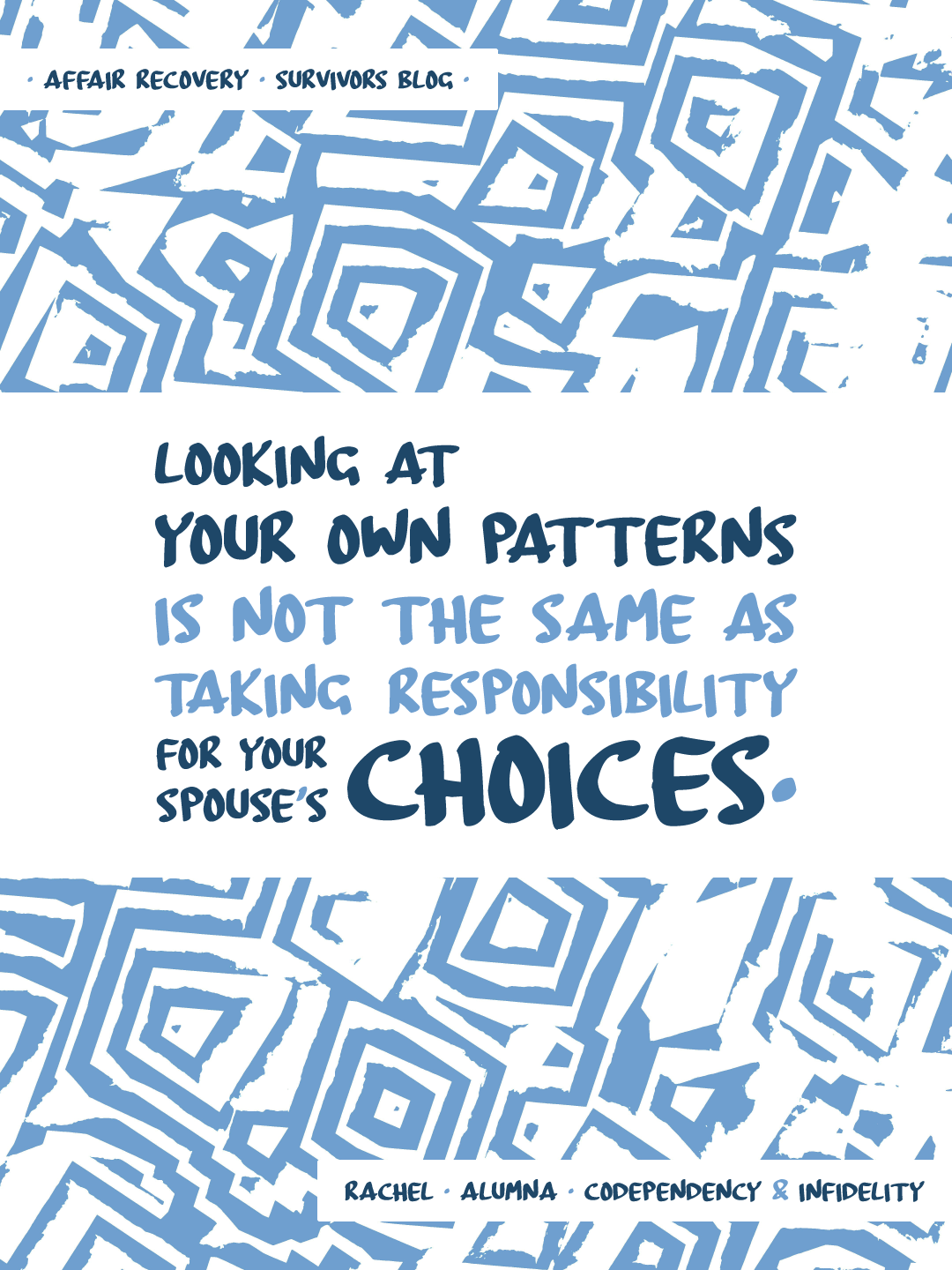
If you’re reading this after betrayal, I want to be clear about something. Looking at your own patterns is not the same as taking responsibility for your spouse’s choices. Recognizing where you contort is about your healing. It doesn’t make you the reason someone chose to betray you.
What it Looks Like Now
I like the way John Haney and Leslie Hardie define codependency in their chapter on the subject in Harboring Hope: “When people are big, and God is small” (from Ed Welch). I also appreciate the way Dr. Alison Cook defines codependency: “a pattern of relating in which you focus so much on other people that you become disconnected from your true self” (from her book, The Best of You).
I wish I could say I’m entirely free of any codependent tendencies, but that wouldn’t be true. I can still feel tension in my body when someone is upset with me, or when I act quickly to move through conflict a little too fast.
But here’s what happens now: I notice, and I become curious. I use the cues my body gives me as information: the tension in my jaw, the fluttering in my chest, the way my stomach churns. They tell me to take a few breaths and not automatically respond.
Codependency isn’t a defect, and it’s not something to feel shame about. It’s a complicated thing to understand, one that’s informed by our childhood, nervous systems, trauma, and relational patterns, among other things. But I don’t believe being codependent is the core of your identity, just as it’s not mine.
I wish I had a tidy answer for how to stop contorting overnight. I don’t. But I’ve learned (and keep learning) to recognize the places where I bend beyond my own limits. I’m learning that I can love others without disappearing into their needs.
Part of that learning has been untangling the guilt that shows up when I ask for something. A need isn’t a demand. Asking for help doesn’t mean I get to control whether the other person says yes. And if someone says no, that doesn’t mean my need was wrong to have. It just means I may need to find another way, or another person, to meet it.
And maybe that’s where healing begins: not by learning to bend further, but by recognizing where we need to stop.
If you’re not sure where to start, try this the next time you feel yourself bending. Notice what your body is telling you. Take a few slow breaths before you respond. Then ask yourself one question. You don’t need an answer right away; asking is the beginning.
If you can relate to any aspects of my story, I want to ask you the same question the nurse asked me years ago: What do you need?
If you want somewhere to start, I put together a short worksheet built around the question the nurse asked me. It walks you through noticing where you’re bending past your limits, naming what you need, and figuring out who can help you meet those needs. [Download the worksheet]
And if you’re untangling these patterns in the aftermath of betrayal, you don’t have to do it alone. Harboring Hope is a small-group course for betrayed spouses, and you don’t need to know what you want for your marriage to begin. If you’d rather start with a conversation, you can schedule a free call with someone who has walked this road too.
What type of affair was it?
Free Surviving Infidelity Bootcamp

Add new comment