
Hope Rising: Companions for the Darkest Roads



When I was a kid, my family took a summer road trip from our home in Houston to Colorado. We left around 8 p.m., when we knew the traffic had mostly calmed down, and drove through the night toward New Mexico, our first stop along the way. This was before cell phones, GPS, and Siri could tell us which roads were closed or offer an alternative route when we missed a turn. Before we left, I watched my dad unfold a large paper map across the kitchen table. He and my mom leaned over it, studying the route while my dad traced the highway lines we would take.
There are plenty of moments I remember about that trip—the cassette tapes my parents kept on repeat (thank you, Dad, for introducing me to The Eagles at a young age), their irritated voices when one of them misread the map, and the questionable roadside restrooms.
But what I remember most is the darkness.
I sat in the back seat of our Chrysler minivan with my face pressed against the window, staring out into the night. My eyes strained to trace the objects in the distance, trying to make sense of what my brain couldn’t quite compute against the speed of the vehicle and the absence of light.
I wasn’t exactly afraid of the dark. I was afraid of how the darkness made me feel.
I didn’t have language for it back then, but I know now that my body braced against the uncertainty of what I couldn’t see.
Where are we?
What's around us?
Where are we going?
How much longer will this last?
Are we safe?
Finally, after hours of traveling this way, a faint haze of light appeared on the horizon. As we inched closer, more lights emerged against the dark backdrop, and a part of me sighed with relief.
The road hadn’t changed. But now I could see where we were.
In some ways, I still respond this way to darkness. Even now, as a 45-year-old woman, I clamor for the window seat on a nighttime flight so I can search the darkness below for lights.
Maybe this is part of why the early days of recovering from intimate betrayal felt so disorienting to me. I couldn’t find the light.
Suddenly, I was forced to ask myself many of the same questions I’d asked from that backseat decades earlier:
Where am I?
How long will this last?
Am I safe?
Only now, the road I couldn’t see was my own life. And there was no paper map spread across the kitchen table showing me how to get from where I was to where I needed to go.
So, I looked to people who were a few steps ahead of me. I desperately wanted some evidence that the darkness I stood in wasn’t all there was.
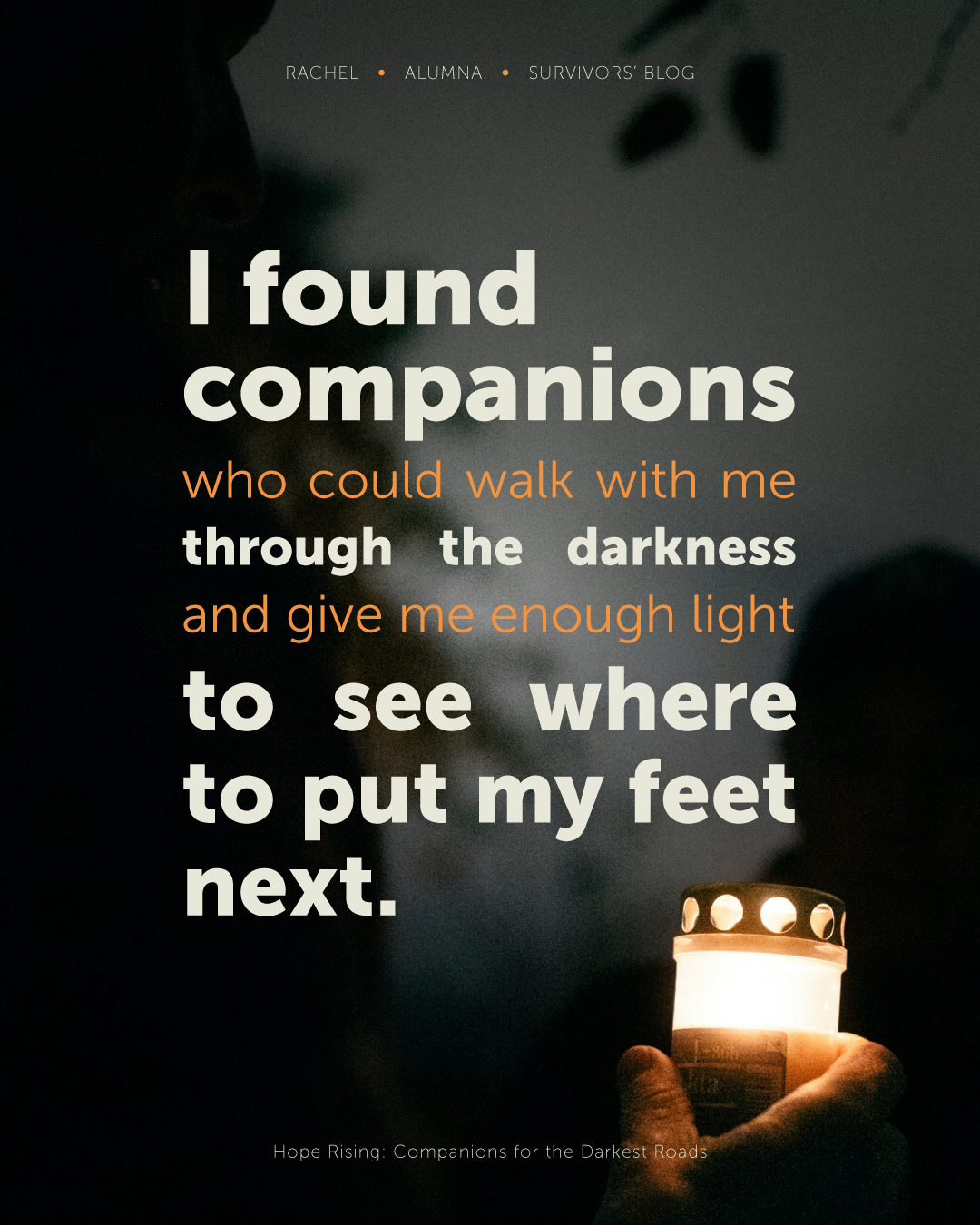
I needed companions who understood the particular grief caused by relational rupture—who knew firsthand the disorientation of a life divided into "before" and "after." I wanted people who could walk through the dark and stay beside me on the long stretch. Companions who could give me enough light to see where to put my feet next. Their presence seemed to say:
Keep going.
Take one more step.
I'm holding the light for you until you can see it again.
Over the years, these companions have shown up in many forms. Therapists and experts gave me language for experiences I didn’t yet know how to name. I still remember the relief of hearing one explain how betrayal can affect the immune system—that what my body was doing was real. Books and therapeutic practices helped, too. So did groups of women navigating their own stories of betrayal—these partners who were willing to tell the truth about both their pain and their healing.
Hope Rising became one of the places I found companions like these. Yes, experts were there, but many of them knew the impact of intimate betrayal from personal experience. I felt reassured as I heard from others who really understood and had traveled the same terrain.
A single word, a phrase, or someone saying in her own way, "I know something about this road, too," became a glimmer of light. And that was enough for me to take the next step.
And the next.
If you feel like you’re standing in the dark and straining to find light, I invite you to explore Hope Rising.
You might benefit from Hope Rising. if:
- You’re in the early days of discovery and need to hear from people who can see farther down the road than you can right now.
- You’re months or years into recovery but need encouragement, perspective, or renewed hope.
- You feel isolated in your experience and long to hear someone put words to something you haven’t known how to explain.
- You want to better understand some of the emotional, physical, relational, and spiritual effects of betrayal.
- You’re rebuilding your marriage, rebuilding yourself, or still trying to figure out what rebuilding looks like for you.
- You want the flexibility to listen and return to certain talks when you need them.
Hope Rising 2026. opens October 1. You’ll have lifetime access and be able to watch privately and at your own pace. Early Bird access is $39 through October 15 (regularly $65). And because every purchase funds the Affair Recovery Scholarship Program, your own step forward helps someone else afford theirs.
You may not be able to see the whole path ahead of you today. Maybe all you see is darkness.
But maybe one of the voices in this collection can hold a little light for you until you can see again.
What type of affair was it?
Free Surviving Infidelity Bootcamp

Add new comment