True Recovery Will Require All of You
Samuel discusses the in's and out's of recovery and personal stories of failure and healing.
Continue reading →
When You're Weary in Recovery
Samuel lays out a recovery protocol for weariness in recovery from the effects from infidelity.
Continue reading →
Does It Ever Go Away?
Samuel answers a pivotal question in recovery: Will all this pain ever go away?
Continue reading →
The Shock of Ambivalence
 Last May was our three-year anniversary post D-day and as I anticipated, it hardly caused a ripple in my emotions. I knew the day was nearing but we were in a good place and we breezed through it without drama, triggers, or setbacks to our recovery. I believed we were finally through the worst that my husband's betrayal could throw at us. We had made it through the fire and while scarred were at last in a better, stronger, safer place.
Then from out of nowhere and without warning, ambivalence hit me like a punch to the gut. It came as a shock this far into recovery. Ambivalence is normal and part of the healing process and I had a lot of it in the months before we took EMS Online. But I thought ambivalence only happened in the early stages of recovery. How could it strike me more than three years later?
Ambivalence is the state of having mixed or contradictory feelings about something or someone. You're of two minds wanting to go in opposite directions. It strikes both the betrayed and unfaithful. Samuel has an excellent article titled "Ambivalence". In it he states,"In many ways, ambivalence can be a cancer which eats away at both sides of the marriage. It's been said the opposite of love is not hate, but indifference, or in this case ambivalence."
I was suddenly afflicted with the cancer of ambivalence and it was eating at the fragile stability of my trust, gnawing at my emotional well-being and chewing at the hard fought victories I had made in recovery. I didn't care if I stayed in the marriage or not. I wasn't happy. I wasn't sad. I wasn't angry. I wasn't good humored. If my husband wanted to go out to eat I didn't care one way or the other. Movie? He can choose. Sex? Whatever. I was blah, going through the motions of my day without emotion or care. I was withdrawn, only talking to my husband when necessary. I knew I should do something but couldn't figure out what and couldn't muster the energy to care enough to start.
And what made it worse was that my husband totally ignored that something was going on. He wasn't oblivious. He couldn't be. He just chose not to reach out to me. It was painful.
One day, several weeks into my malaise I called my mother and begged her for help. She asked me if I wanted a divorce. The answer was no. Then she told me what I already knew I had to do. I had to talk to my husband. He admitted that he knew something was wrong but didn't know how to talk to me about it. I told him that I needed his help to get through my ambivalence. I was specific in my requests. I needed him to reach out to me with more hugs, touching, and affection without it leading to sex. I required him to reassure me that he's thinking about me and needing me throughout the day with texts. I needed him to reach out to me when I'm withdrawn and keeping to myself.
He tried but it only lasted a few days and my ambivalence raged on, engulfing my every waking moment and overwhelming me with its intensity. I quit reading everything related to Affair Recovery thinking that being exposed to the pain of others was adding to my problems. I tried forcing myself to be intentional in my actions towards my husband which had always worked in the past. I did a lot of self-reflection attempting to figure out where the ambivalence was coming from.
I gradually began to connect with a separate incident that was happening at the same time with my ambivalence and the pieces finally came together. My husband had told me early on during recovery that one of his reasons for betrayal was that he felt a lack of intimacy in our marriage. That lack of intimacy was directly related to the fact that years ago when he gained weight it caused him to snore. He started occasionally sleeping in the spare room which eventually led to sleeping there every night. Over the years our intimacy suffered and so did our relationship. After D-day, we started sleeping together again and I bought earplugs to help me cope with the snoring. He eventually lost enough weight that the snoring rarely became a problem.
But now he had gained the weight back and suddenly he's sleeping in the guest room, just like before. This is a huge trigger for me. The longer he sleeps in the guest room, the more worried I get about losing intimacy and the negative repercussion this could have for our relationship. I have mentioned my fears to my husband several times but he doesn't seem to care. If he's not concerned about our relationship, why should I be bothered?
After working this out in my mind I talked to my husband again this time explaining that I believed my ambivalence may in part be coming from the fact that we're not sleeping together again. I got nowhere.
I wish I could say that my husband stepped up and fulfilled my needs helping my ambivalence disappear quickly. Unfortunately, that's not the case. Was I asking too much of him? Possibly. Unrealistic and unmet expectations can be another cancer that eats at a marriage. But what I will tell you is that he hasn't used these past months as an excuse to be angry or frustrated or hateful to me. He's given me the space that I need to work through my emotions. And while he's not been supportive in the way that I had hoped he has been solidly supportive by always being there without judgment.
We aren't sleeping together yet but he has finally decided to lose weight. There's progress. Not as fast as I would have liked but progress. The ambivalence has been slowly seeping away like fog as the brilliance of the sun burns it off. There are still wispy tendrils left, sneaking around in low spots, trying to wrap around and hide in dark corners of my heart. But the sun is doing its work one day at a time and I can finally see the horizon.
I've learned that just because we're years down the road since D-day, that doesn't mean my or our recovery is perfect. We had become somewhat complacent but have discovered that it's important to be prepared for anything as we navigate the quagmire of recovery. If I hadn't been committed to my goal of a better, more honest, more respectful marriage I may have given up. If my husband had allowed my ambivalence to cause him to be impatient or frustrated with me he may have given up. It would have been easy for him to say it's been three years, get over it! Luckily he didn't.
I recommend reading Rick's superb articles, "The Paralysis of Ambivalence: Part 1" and "Part 2". Ambivalence is normal but it doesn't have to be a deal breaker. There is hope.
Last May was our three-year anniversary post D-day and as I anticipated, it hardly caused a ripple in my emotions. I knew the day was nearing but we were in a good place and we breezed through it without drama, triggers, or setbacks to our recovery. I believed we were finally through the worst that my husband's betrayal could throw at us. We had made it through the fire and while scarred were at last in a better, stronger, safer place.
Then from out of nowhere and without warning, ambivalence hit me like a punch to the gut. It came as a shock this far into recovery. Ambivalence is normal and part of the healing process and I had a lot of it in the months before we took EMS Online. But I thought ambivalence only happened in the early stages of recovery. How could it strike me more than three years later?
Ambivalence is the state of having mixed or contradictory feelings about something or someone. You're of two minds wanting to go in opposite directions. It strikes both the betrayed and unfaithful. Samuel has an excellent article titled "Ambivalence". In it he states,"In many ways, ambivalence can be a cancer which eats away at both sides of the marriage. It's been said the opposite of love is not hate, but indifference, or in this case ambivalence."
I was suddenly afflicted with the cancer of ambivalence and it was eating at the fragile stability of my trust, gnawing at my emotional well-being and chewing at the hard fought victories I had made in recovery. I didn't care if I stayed in the marriage or not. I wasn't happy. I wasn't sad. I wasn't angry. I wasn't good humored. If my husband wanted to go out to eat I didn't care one way or the other. Movie? He can choose. Sex? Whatever. I was blah, going through the motions of my day without emotion or care. I was withdrawn, only talking to my husband when necessary. I knew I should do something but couldn't figure out what and couldn't muster the energy to care enough to start.
And what made it worse was that my husband totally ignored that something was going on. He wasn't oblivious. He couldn't be. He just chose not to reach out to me. It was painful.
One day, several weeks into my malaise I called my mother and begged her for help. She asked me if I wanted a divorce. The answer was no. Then she told me what I already knew I had to do. I had to talk to my husband. He admitted that he knew something was wrong but didn't know how to talk to me about it. I told him that I needed his help to get through my ambivalence. I was specific in my requests. I needed him to reach out to me with more hugs, touching, and affection without it leading to sex. I required him to reassure me that he's thinking about me and needing me throughout the day with texts. I needed him to reach out to me when I'm withdrawn and keeping to myself.
He tried but it only lasted a few days and my ambivalence raged on, engulfing my every waking moment and overwhelming me with its intensity. I quit reading everything related to Affair Recovery thinking that being exposed to the pain of others was adding to my problems. I tried forcing myself to be intentional in my actions towards my husband which had always worked in the past. I did a lot of self-reflection attempting to figure out where the ambivalence was coming from.
I gradually began to connect with a separate incident that was happening at the same time with my ambivalence and the pieces finally came together. My husband had told me early on during recovery that one of his reasons for betrayal was that he felt a lack of intimacy in our marriage. That lack of intimacy was directly related to the fact that years ago when he gained weight it caused him to snore. He started occasionally sleeping in the spare room which eventually led to sleeping there every night. Over the years our intimacy suffered and so did our relationship. After D-day, we started sleeping together again and I bought earplugs to help me cope with the snoring. He eventually lost enough weight that the snoring rarely became a problem.
But now he had gained the weight back and suddenly he's sleeping in the guest room, just like before. This is a huge trigger for me. The longer he sleeps in the guest room, the more worried I get about losing intimacy and the negative repercussion this could have for our relationship. I have mentioned my fears to my husband several times but he doesn't seem to care. If he's not concerned about our relationship, why should I be bothered?
After working this out in my mind I talked to my husband again this time explaining that I believed my ambivalence may in part be coming from the fact that we're not sleeping together again. I got nowhere.
I wish I could say that my husband stepped up and fulfilled my needs helping my ambivalence disappear quickly. Unfortunately, that's not the case. Was I asking too much of him? Possibly. Unrealistic and unmet expectations can be another cancer that eats at a marriage. But what I will tell you is that he hasn't used these past months as an excuse to be angry or frustrated or hateful to me. He's given me the space that I need to work through my emotions. And while he's not been supportive in the way that I had hoped he has been solidly supportive by always being there without judgment.
We aren't sleeping together yet but he has finally decided to lose weight. There's progress. Not as fast as I would have liked but progress. The ambivalence has been slowly seeping away like fog as the brilliance of the sun burns it off. There are still wispy tendrils left, sneaking around in low spots, trying to wrap around and hide in dark corners of my heart. But the sun is doing its work one day at a time and I can finally see the horizon.
I've learned that just because we're years down the road since D-day, that doesn't mean my or our recovery is perfect. We had become somewhat complacent but have discovered that it's important to be prepared for anything as we navigate the quagmire of recovery. If I hadn't been committed to my goal of a better, more honest, more respectful marriage I may have given up. If my husband had allowed my ambivalence to cause him to be impatient or frustrated with me he may have given up. It would have been easy for him to say it's been three years, get over it! Luckily he didn't.
I recommend reading Rick's superb articles, "The Paralysis of Ambivalence: Part 1" and "Part 2". Ambivalence is normal but it doesn't have to be a deal breaker. There is hope.
Last May was our three-year anniversary post D-day and as I anticipated, it hardly caused a ripple in my emotions. I knew the day was nearing but we were in a good place and we breezed through it without drama, triggers, or setbacks to our recovery. I believed we were finally through the worst that my husband's betrayal could throw at us. We had made it through the fire and while scarred were at last in a better, stronger, safer place.
Then from out of nowhere and without warning, ambivalence hit me like a punch to the gut. It came as a shock this far into recovery. Ambivalence is normal and part of the healing process and I had a lot of it in the months before we took EMS Online. But I thought ambivalence only happened in the early stages of recovery. How could it strike me more than three years later?
Ambivalence is the state of having mixed or contradictory feelings about…
Continue reading →
Help to Surviving the Dark Days of Recovery
Samuel shares humorous but effective stories about how to make it though the dark days of recovery.
Continue reading →
You Must Know Why You or Your Spouse Cheated
Samuel tackles a sensitive subject: understanding the importance of why a spouse cheats.
Continue reading →
Choosing How the Pain Affects Us
Samuel shares insight into the choice we have in dealing with the pain of infidelity.
Continue reading →
5 Reasons the Betrayed Spouse Gets Stuck in Recovery
Samuel provides insight into just a few reasons the betrayed spouse can find their recovery paralyzed.
Continue reading →
When It Hurts to Draw Boundaries in Recovery
Samuel answers questions about how to handle the pain of ending dysfunction in recovery.
Continue reading →
5 Reasons the Unfaithful Spouse Remains Stuck
Samuel shares five significant reasons unfaithful spouses remain stuck in their situation.
Continue reading →
Are You Enabling Your Unfaithful Spouse?
Today Samuel tackles a complex but important topic in infidelity: enablement.
Continue reading →
Understanding Grief in Infidelity
 2 Part Series:
Do You Struggle with Forgiveness?
Understanding Grief in Infidelity
This week we have Part Two of Mona Shriver's guest post. We've heard nothing but wonderful reviews of last week's article on forgiveness, and this week Mona shares specifically on the need for grief in recovery. Grief can be perplexing, especially as it pertains to infidelity, but after reading Mona's article we hope you'll find that it is necessary, incredibly transformational, and provides a pathway to personal and marital healing. Grief also provides a pathway through what can feel like uncontrollable anger.
The trauma of infidelity is huge. The healing process can be overwhelming and convoluted. When we began our own journey in 1993 there were few resources. We did find a good counselor and we worked hard. We healed. We grew. Neither of us is the same person we were before we went through the healing process to rebuild our marriage. And quite frankly, we're glad. We like ourselves and each other a whole lot more.
Going Through It Alone
One of the needs that soon surfaced after the revelation was to be able to talk with another couple who'd successfully navigated infidelity. Someone to tell us it was worth trying to heal. Someone who could look us in the eyes and tell us it really was possible to enjoy each other again. Someone who had done it. Our pastor and counselor told us they were out there, but we never found them. Two years later our counselor approached us to be that couple for someone else and a ministry was born. Hope & Healing Ministries, Inc. is a Christian peer support ministry for couples in infidelity recovery. We met Rick Reynolds and became acquainted with Affair Recovery many years ago at a conference. We, and the couples we serve, have benefitted greatly from the resources available through Affair Recovery, and it is an honor to offer some insights through this much needed resource.
One of the things I didn't comprehend at the beginning was the depth of the grieving process those of us who have been betrayed must walk through. Oh, certainly I knew that I would grieve many losses in my marriage. It didn't take long at all to understand I'd lost the husband I thought I had - I hadn't for one moment thought Gary was capable of this. I knew I'd lost the "good marriage" I thought we'd had - one that was above this threat. I knew I'd lost my image of myself - a woman who would know if something was wrong and couldn't be deceived. I knew immediately there had been losses. I'd felt the floor fall out from underneath me. My security and stability were far beyond my reach, even my strong faith wobbled in fear and disappointment. But I still didn't understand grieving then. Anger I could understand, but grief was foreign.
Understanding Grief
Grief is defined as deep mental anguish, deep sorrow. Frankly I didn't realize just how "deep" that deep was or what it would take to work my way back up through it. We often tell couples that the revelation of infidelity is comparable to the sudden death of someone you love. I've lost count of how many look me in the eye and say, "this is worse."
How can that be? The big difference is twofold in my opinion.
First, the wound of adultery is personal and feels intentional. It's inflicted by the one we trusted most. Even if there wasn't trust in the marriage, there was always hope they would someday become that person we could trust. Second, those of us experiencing adultery are not supported in the same way as those who experience a death. With death, everyone knows. They grieve with you. They bring meals, send flowers, and go out of their way to help you through this difficult time. And there's ritual - a funeral or memorial. The world stops for just a moment to note this significant event. They encourage us. Tell us we can make it. They don't advise us to give up on healing. In the case of infidelity, if the healing hasn't occurred in the timetable those outside the marriage believe is acceptable, they tell us to get out of the relationship or suck it up and move on. I often wonder if some of those couples who just "couldn't heal" got stuck in the grief of the betrayal.
Fortunately, a lot of excellent work has been done on grieving in the past few years. One of the things we've learned is that pain does not just go away with time. Dr. Gary Rosberg says it best: "You can bury pain, but you bury it alive."1 The pain will work its way out eventually and cause even more damage.
When we attempt to bury the pain or stuff it down, anger emerges, and seemingly compounds almost daily. Betrayed spouses wonder if they will ever be able to diffuse or overcome what feels like raw rage, especially since nothing they have tried has given them any traction. It's a common prescription to betrayed spouses to "just forgive and you won't be angry anymore." I'm sorry, but that's just not usually true. A betrayed spouse who is dealing with severe anger will need to actually grieve first, then slowly and steadily move towards forgiveness.
But grieve what you ask?
They may grieve the loss of the marriage they thought they had. They may grieve the life they thought they were going to live, free of infidelity or addiction. They may also have to grieve for the consequences that have arisen due to their spouse's or partner's actions. They may grieve the image they had of their spouse or even of themselves.
Grieving vs. Mourning
The Center for Loss and Life Transition in Fort Collins, Colorado is run by Dr. Alan Wolfelt, a noted grief counselor. One of the profound findings they teach is that there is a difference between grieving and mourning. He says this about grieving a death, but I believe it applies to any grieving process:
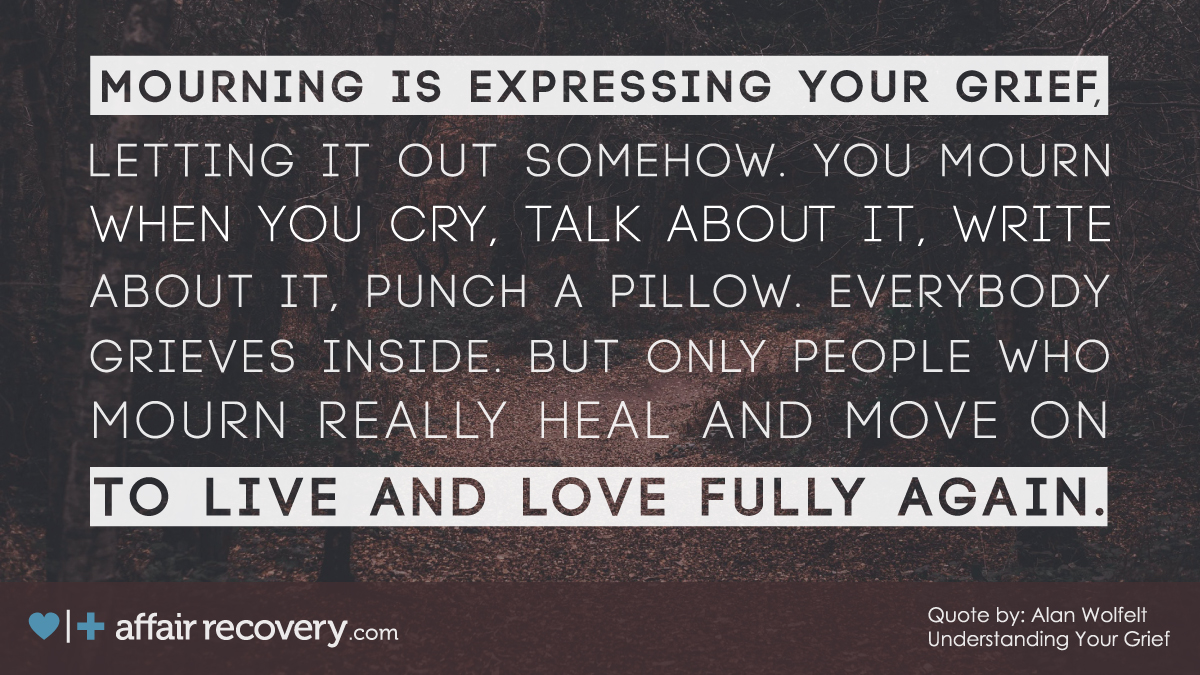
Grief is what you think and feel on the inside. It's numbness, sadness, anger, regret, and sometimes relief, all rolled up into one. It's a pain in your gut and a hold in your chest. Mourning is expressing your grief, letting it out somehow. You mourn when you cry, talk about it, write about it, punch a pillow. Everybody grieves inside. But only people who mourn really heal and move on to live and love fully again.2
- Dr. Alan Wolfelt
So what does that have to do with infidelity? It means no matter what does or doesn't happen with your marriage, no matter what does or doesn't happen with the pain caused by the betrayal, your ability to grieve well will greatly influence the rest of your life and the lives of those with whom you connect. So we need to consciously make grieving and mourning a part of our recovery process.
What does that look like? First, there is no right or wrong way to grieve, but there are healthy ways to cope with the pain. I believe there are three simple principles which can help guide us in a healthy way.
Recognize the Depth of the Pain
None of us have a problem recognizing there is pain associated with the revelation of infidelity, but I believe we underestimate the depth. At the very least, those who surround us do. And that can include the unfaithful spouse. Betrayed spouses are often allotted a specified period of time to come to grips with what has happened, process it, and move on. The irony is that few, if any, of those who offer this advice would ever say something similar to someone who had experienced a death. Because that expectation is so often communicated, it follows that the betrayed spouse expects this of his or herself. So when s/he finds that six, eight, ten months later s/he is still a mess, his/her mind begins to wonder if healing is really possible. I speak with so many betrayed spouses that share a story along these lines. I listen and then ask one question: "If your spouse had suddenly died 8 or 10 months ago, would you be surprised that you're still struggling?" I've yet to have even one say "yes".
Recognizing the depth of the pain gives us permission to seek healthy ways to mourn instead of wasting so much of our energy trying not to feel the way we do. It would also help those who support us if they understood this principle because they could encourage the one grieving to do the mourning necessary to heal.
Self-Care
The truth is that experiencing this trauma and the grief that accompanies it is exhausting. It takes a lot physically, emotionally, and spiritually to work a healing- process after a deep wound like infidelity. So why do so many of us try to continue on as normal? The problem with "pretending normal" (as Rick calls it) is that we fail miserably and exhaust our resources even more in those efforts.
We tell couples to treat themselves like they were in a severe car accident. Just because you can't see the wound doesn't mean it won't begin to fester without proper care. You wouldn't try to do everything like normal if you had a broken leg or internal bleeding, so stop anything that isn't essential. It will take all you have to just do the necessaries of life. Of course, the difference is no one else can see our broken and bleeding wound, but we can say we're sick. Because the truth is, we are.
And this is where we can help each other. Gary and I tended to take turns being incapacitated. It wasn't anything we planned but it did seem to work out that way. And one of the things we could do for each other - and there weren't a whole lot of those during that time - was give the other person some time and space for extra rest when we ourselves had a bit more energy. In fact, one of the suggestions from our counselor was for Gary to provide me with the opportunity for time alone to do some writing. He took care of the house and kids so I could have a few hours alone to do some of that mourning work. It ended up helping both of us.
Don't Do It Alone
When we were working through recovery, it was the first time in my life I wondered if I would even survive. I found myself totally inadequate. It frightened me and made me question myself. I had simply never experienced trauma and grief at this level, even though I'd experienced the death of a nephew and my father. I had always been the strong, resilient one.
As we've worked with couples in groups, I've seen the value of support. They walk into our first meeting uncertain and wary, their pain obvious even in the way they hold themselves. After experiencing support, there is a noticeable difference. As one person put it, "It's been a refreshing time as opposed to the heaviness of these past weeks".
Grief support groups have become widely accepted as therapeutic and extremely helpful. They are highly recommended to those who have recently experienced a death. People find healing and hope there. We find the same things in that setting for those in infidelity recovery. Very often we hear someone say they finally understand what their spouse and others have been trying to convey for a long time. It's not because we have some extra special words to convey the message, it's simply the dynamics of a group. For me, my final and complete healing came through this support system. I remember clearly stating I had completely healed and realizing it had happened sometime in the past. It had come as we worked with others.
Go through the grieving process. Do the mourning necessary. Access and utilize the expert resources you need to heal. It's the best gift you can give yourself, your kids, and those with whom you do life. And we want to encourage you to continue on so you can process this trauma and heal. It's worth it. I can say that because we did it and I will never regret working through the grief.
Continue Your Healing With EMS Online! Registration Opens Soon.
Our Emergency Marital Seminar Online, better known as EMSO, isn't a one-size-fits-all program for couples. Over decades of experience exclusively in the field of infidelity, our methodology has been honed to better serve couples as they address the betrayal, reconnect as partners and restore their lives.
"I would like to say thank you, from the bottom of my heart, for your ministry and the materials you have provided as part of EMSO and Married for Life. We, all five couples that started EMSO, have just completed the Married for Life 52-week course. We are now deciding what to study next as a group, as we so value the relationship we have together as couples. With God, with your materials and with each other, we have saved our marriages." - B. Minnesota | EMSO participant, March 2021.
Spots fill up quickly, so you won't want to wait to register for EMSO! To learn when registration opens back up, click the button below.
Subscribe to Registration Notifications!
Rosberg, Gary and Barbara. Healing the Hurt in Your Marriage. 2004. PDF.
Wolfelt, Alan. Understanding Your Grief: Ten Essential Touchstones for Finding Hope and Healing Your Heart. Fort Collins, CO: Companion Press, 2003. eBook.
2 Part Series:
Do You Struggle with Forgiveness?
Understanding Grief in Infidelity
This week we have Part Two of Mona Shriver's guest post. We've heard nothing but wonderful reviews of last week's article on forgiveness, and this week Mona shares specifically on the need for grief in recovery. Grief can be perplexing, especially as it pertains to infidelity, but after reading Mona's article we hope you'll find that it is necessary, incredibly transformational, and provides a pathway to personal and marital healing. Grief also provides a pathway through what can feel like uncontrollable anger.
The trauma of infidelity is huge. The healing process can be overwhelming and convoluted. When we began our own journey in 1993 there were few resources. We did find a good counselor and we worked hard. We healed. We grew. Neither of us is the same person we were before we went through the healing process to rebuild our marriage. And quite frankly, we're glad. We like ourselves and each other a whole lot more.
Going Through It Alone
One of the needs that soon surfaced after the revelation was to be able to talk with another couple who'd successfully navigated infidelity. Someone to tell us it was worth trying to heal. Someone who could look us in the eyes and tell us it really was possible to enjoy each other again. Someone who had done it. Our pastor and counselor told us they were out there, but we never found them. Two years later our counselor approached us to be that couple for someone else and a ministry was born. Hope & Healing Ministries, Inc. is a Christian peer support ministry for couples in infidelity recovery. We met Rick Reynolds and became acquainted with Affair Recovery many years ago at a conference. We, and the couples we serve, have benefitted greatly from the resources available through Affair Recovery, and it is an honor to offer some insights through this much needed resource.
One of the things I didn't comprehend at the beginning was the depth of the grieving process those of us who have been betrayed must walk through. Oh, certainly I knew that I would grieve many losses in my marriage. It didn't take long at all to understand I'd lost the husband I thought I had - I hadn't for one moment thought Gary was capable of this. I knew I'd lost the "good marriage" I thought we'd had - one that was above this threat. I knew I'd lost my image of myself - a woman who would know if something was wrong and couldn't be deceived. I knew immediately there had been losses. I'd felt the floor fall out from underneath me. My security and stability were far beyond my reach, even my strong faith wobbled in fear and disappointment. But I still didn't understand grieving then. Anger I could understand, but grief was foreign.
Understanding Grief
Grief is defined as deep mental anguish, deep sorrow. Frankly I didn't realize just how "deep" that deep was or what it would take to work my way back up through it. We often tell couples that the revelation of infidelity is comparable to the sudden death of someone you love. I've lost count of how many look me in the eye and say, "this is worse."
How can that be? The big difference is twofold in my opinion.
First, the wound of adultery is personal and feels intentional. It's inflicted by the one we trusted most. Even if there wasn't trust in the marriage, there was always hope they would someday become that person we could trust. Second, those of us experiencing adultery are not supported in the same way as those who experience a death. With death, everyone knows. They grieve with you. They bring meals, send flowers, and go out of their way to help you through this difficult time. And there's ritual - a funeral or memorial. The world stops for just a moment to note this significant event. They encourage us. Tell us we can make it. They don't advise us to give up on healing. In the case of infidelity, if the healing hasn't occurred in the timetable those outside the marriage believe is acceptable, they tell us to get out of the relationship or suck it up and move on. I often wonder if some of those couples who just "couldn't heal" got stuck in the grief of the betrayal.
Fortunately, a lot of excellent work has been done on grieving in the past few years. One of the things we've learned is that pain does not just go away with time. Dr. Gary Rosberg says it best: "You can bury pain, but you bury it alive."1 The pain will work its way out eventually and cause even more damage.
When we attempt to bury the pain or stuff it down, anger emerges, and seemingly compounds almost daily. Betrayed spouses wonder if they will ever be able to diffuse or overcome what feels like raw rage, especially since nothing they have tried has given them any traction. It's a common prescription to betrayed spouses to "just forgive and you won't be angry anymore." I'm sorry, but that's just not usually true. A betrayed spouse who is dealing with severe anger will need to actually grieve first, then slowly and steadily move towards forgiveness.
But grieve what you ask?
They may grieve the loss of the marriage they thought they had. They may grieve the life they thought they were going to live, free of infidelity or addiction. They may also have to grieve for the consequences that have arisen due to their spouse's or partner's actions. They may grieve the image they had of their spouse or even of themselves.
Grieving vs. Mourning
The Center for Loss and Life Transition in Fort Collins, Colorado is run by Dr. Alan Wolfelt, a noted grief counselor. One of the profound findings they teach is that there is a difference between grieving and mourning. He says this about grieving a death, but I believe it applies to any grieving process:
Grief is what you think and feel on the inside. It's numbness, sadness, anger, regret, and sometimes relief, all rolled up into one. It's a pain in your gut and a hold in your chest. Mourning is expressing your grief, letting it out somehow. You mourn when you cry, talk about it, write about it, punch a pillow. Everybody grieves inside. But only people who mourn really heal and move on to live and love fully again.2
- Dr. Alan Wolfelt
So what does that have to do with infidelity? It means no matter what does or doesn't happen with your marriage, no matter what does or doesn't happen with the pain caused by the betrayal, your ability to grieve well will greatly influence the rest of your life and the lives of those with whom you connect. So we need to consciously make grieving and mourning a part of our recovery process.
What does that look like? First, there is no right or wrong way to grieve, but there are healthy ways to cope with the pain. I believe there are three simple principles which can help guide us in a healthy way.
Recognize the Depth of the Pain
None of us have a problem recognizing there is pain associated with the revelation of infidelity, but I believe we underestimate the depth. At the very least, those who surround us do. And that can include the unfaithful spouse. Betrayed spouses are often allotted a specified period of time to come to grips with what has happened, process it, and move on. The irony is that few, if any, of those who offer this advice would ever say something similar to someone who had experienced a death. Because that expectation is so often communicated, it follows that the betrayed spouse expects this of his or herself. So when s/he finds that six, eight, ten months later s/he is still a mess, his/her mind begins to wonder if healing is really possible. I speak with so many betrayed spouses that share a story along these lines. I listen and then ask one question: "If your spouse had suddenly died 8 or 10 months ago, would you be surprised that you're still struggling?" I've yet to have even one say "yes".
Recognizing the depth of the pain gives us permission to seek healthy ways to mourn instead of wasting so much of our energy trying not to feel the way we do. It would also help those who support us if they understood this principle because they could encourage the one grieving to do the mourning necessary to heal.
Self-Care
The truth is that experiencing this trauma and the grief that accompanies it is exhausting. It takes a lot physically, emotionally, and spiritually to work a healing- process after a deep wound like infidelity. So why do so many of us try to continue on as normal? The problem with "pretending normal" (as Rick calls it) is that we fail miserably and exhaust our resources even more in those efforts.
We tell couples to treat themselves like they were in a severe car accident. Just because you can't see the wound doesn't mean it won't begin to fester without proper care. You wouldn't try to do everything like normal if you had a broken leg or internal bleeding, so stop anything that isn't essential. It will take all you have to just do the necessaries of life. Of course, the difference is no one else can see our broken and bleeding wound, but we can say we're sick. Because the truth is, we are.
And this is where we can help each other. Gary and I tended to take turns being incapacitated. It wasn't anything we planned but it did seem to work out that way. And one of the things we could do for each other - and there weren't a whole lot of those during that time - was give the other person some time and space for extra rest when we ourselves had a bit more energy. In fact, one of the suggestions from our counselor was for Gary to provide me with the opportunity for time alone to do some writing. He took care of the house and kids so I could have a few hours alone to do some of that mourning work. It ended up helping both of us.
Don't Do It Alone
When we were working through recovery, it was the first time in my life I wondered if I would even survive. I found myself totally inadequate. It frightened me and made me question myself. I had simply never experienced trauma and grief at this level, even though I'd experienced the death of a nephew and my father. I had always been the strong, resilient one.
As we've worked with couples in groups, I've seen the value of support. They walk into our first meeting uncertain and wary, their pain obvious even in the way they hold themselves. After experiencing support, there is a noticeable difference. As one person put it, "It's been a refreshing time as opposed to the heaviness of these past weeks".
Grief support groups have become widely accepted as therapeutic and extremely helpful. They are highly recommended to those who have recently experienced a death. People find healing and hope there. We find the same things in that setting for those in infidelity recovery. Very often we hear someone say they finally understand what their spouse and others have been trying to convey for a long time. It's not because we have some extra special words to convey the message, it's simply the dynamics of a group. For me, my final and complete healing came through this support system. I remember clearly stating I had completely healed and realizing it had happened sometime in the past. It had come as we worked with others.
Go through the grieving process. Do the mourning necessary. Access and utilize the expert resources you need to heal. It's the best gift you can give yourself, your kids, and those with whom you do life. And we want to encourage you to continue on so you can process this trauma and heal. It's worth it. I can say that because we did it and I will never regret working through the grief.
Continue Your Healing With EMS Online! Registration Opens Soon.
Our Emergency Marital Seminar Online, better known as EMSO, isn't a one-size-fits-all program for couples. Over decades of experience exclusively in the field of infidelity, our methodology has been honed to better serve couples as they address the betrayal, reconnect as partners and restore their lives.
"I would like to say thank you, from the bottom of my heart, for your ministry and the materials you have provided as part of EMSO and Married for Life. We, all five couples that started EMSO, have just completed the Married for Life 52-week course. We are now deciding what to study next as a group, as we so value the relationship we have together as couples. With God, with your materials and with each other, we have saved our marriages." - B. Minnesota | EMSO participant, March 2021.
Spots fill up quickly, so you won't want to wait to register for EMSO! To learn when registration opens back up, click the button below.
Subscribe to Registration Notifications!
Rosberg, Gary and Barbara. Healing the Hurt in Your Marriage. 2004. PDF.
Wolfelt, Alan. Understanding Your Grief: Ten Essential Touchstones for Finding Hope and Healing Your Heart. Fort Collins, CO: Companion Press, 2003. eBook.
2 Part Series:
Do You Struggle with Forgiveness?
Understanding Grief in Infidelity
This week we have Part Two of Mona Shriver's guest post. We've heard nothing but wonderful reviews of last week's article on forgiveness, and this week Mona shares specifically on the need for grief in recovery. Grief can be perplexing, especially as it pertains to infidelity, but after reading Mona's article we hope you'll find that it is necessary, incredibly transformational, and provides a pathway to personal and marital healing. Grief also provides a pathway through what can feel like uncontrollable anger.
The trauma of infidelity is huge. The healing process can be overwhelming and convoluted. When we began our own journey in 1993 there were few resources. We did find a good counselor and we worked hard. We healed. We grew. Neither of us is the same person we were before we went…
Continue reading →
Why Unfaithful Spouses Constantly Resort to Blame?
Samuel shares insight into why the choice to blame is so enticing for unfaithful spouses.
Continue reading →
"I'm Going to Be OK Even If the Marriage Isn't"
Samuel share a pivotal point of healing for both himself and Samantha during one of the most difficult times in their recovery.
Continue reading →
Do You Struggle with Forgiveness?
 2 Part Series:
Do You Struggle with Forgiveness?
Understanding Grief in Infidelity
This week we hear from a wonderful friend and fellow survivor of infidelity. Mona Shriver and her husband, Gary, co-founded Hope and Healing Ministries, offering support to couples working through infidelity, in 1998 after their own experience with infidelity recovery. Gary and Mona authored the book, Unfaithful: Hope & Healing after Infidelity and Mona has authored additional articles online and in magazines.
It happened again. Another couple. Same stumbling block.
My husband and I come alongside couples in infidelity recovery through a Christian peer support ministry, Hope & Healing. We have for almost twenty years now. We co-founded the ministry with another couple a few years after our own experience with infidelity and healing. We've written a book that deals with betrayal from a couple's perspective - what healing looks like behind closed doors - and we talk with many couples. We've learned a lot from experts in the field, like Rick Reynolds and Affair Recovery. We understand the value of educating yourself about this journey called "healing" from infidelity.
It's not uncommon to hear an unfaithful spouse say, "If he/she would just forgive me we could move forward." They believe that forgiveness is the stumbling block they keep running into.
What we've discovered is this: It very often has little to do with forgiveness and much more to do with our misconceived ideas of what forgiveness looks like. Most often what they're talking about is trust.
What Forgiveness Is Not
First we must understand what forgiveness is not. I really struggled with forgiveness after my husband's infidelity. I was trying to do what my family had taught me about forgiveness, which really wasn't all that healthy. Frankly I wasn't getting anywhere. The harder I tried, the harder it got and the more confused I became. So out of desperation I set out to find some answers, and it quickly became clear that one of the reasons I was struggling was because what I was trying to do wasn't even forgiveness. So I had to undo some learning.
Forgiveness is not managing my emotions. It's not pretending it didn't hurt, cause anger or inflict pain. In fact, forgiveness does not immediately diminish the pain.
Forgiveness is not a denial of wrongdoing. It doesn't justify what someone did or let them off the moral hook. It doesn't say there are no consequences. Yet so many of us who struggle with forgiveness tell ourselves that forgiving sends the message that the betrayal was okay. This is so not true.
Forgiveness is not an excuse. It does not remove the responsibility for the harm done. It's not saying the pain is over forever or that we understand how we got to this place in our marriage. If that were true forgiveness wouldn't cost us anything, and it always does.
Forgiveness is not forgetting. It's not some form of sentimental amnesia. There is no such thing as forgive and forget. Forgetting is impossible. How can you forget something that caused so much pain? Would you ever forget the car wreck that put you in ICU for a week? Of course not. You'd remember, but you probably wouldn't dwell on the memory; it wouldn't stop you from living. You would eventually be able to drive a car again, though perhaps with a few extra scars.
Forgiveness is not trust. Trust is a whole other subject. Affair Recovery has one of the best articles I've ever read on the subject, The Shocking Truth about Trust. I'd encourage you to obtain a copy. But for right now, let's just agree forgiveness is not trust.
Finally, forgiveness is not reconciliation. Reconciliation requires forgiveness and trust. It's about committing to a future with someone, while forgiveness simply means accepting the past.
So What Is Forgiveness?
Various dictionaries define forgiveness as "ceasing to demand a penalty for, ceasing to blame". It's giving up a claim for payment. The Hebrew and Greek words that translate to forgive generally mean "to send away, release, set free, or offer a gift of grace". The intent is to cut something loose, like the weight of resentment for being wronged. Forgiveness is more a behavior than a feeling.
What does that look like with real hurts, like betrayal? How do we grasp that concept in a practical way? Author and Pastor Dr. Charles Stanley describes a three-step process that helped me personally in my own journey.1
First, it's about recognizing there's been an injury. This is not too difficult when we're talking about adultery. Second, it's about admitting there's a debt - that something has to be done for that injury. There is something inside all of us that cries out for justice when there's been a wrong inflicted. I see that as the debt owed - justice is due! Then finally, it's about ME releasing you from what is due for that injury.
Let me give you a practical, oversimplified example. You borrow my new car. You drive recklessly and trash it. The injury occurred. Once I know about the car, I say, "You trashed my new car. You owe me a clean, functioning car." The debt has been acknowledged. But then step three comes in. I tell you, "But you know what? You don't have to pay that debt." I have just "forgiven" you. It doesn't mean I'm not angry. It doesn't mean I haven't incurred a loss. It just means you don't have to pay.
Of course there are a couple of big problems here. One, adultery is much bigger than a broken vehicle. Two, the forgiveness costs a whole lot more than a new car. But here is where I think so many of us struggle: First, some of us try to bypass the "you owe me" part. It just doesn't feel right to demand payment, even though everything in us and every behavior loudly proclaims that it's owed. But how can I release you from something I've never acknowledged? How can I let go of something I've never held in my hand?
The second problem is our refusal to let go of that demand for justice because "something" has to be done. Yet we have no idea what and we get stuck. In reality, what can ever compensate for some of the wrongs done to us? Even the death penalty doesn't take away the injustice or the pain. If I hang onto what you owe I'm always looking back and dragging the weight of your wrongdoing around with me. The longer I do, the heavier it becomes. The problem is that it's on my back, not yours.
If I can release that claim, I can be free of the burden of trying to obtain what in some cases is impossible. More importantly, I can cease to allow what happened to forever have power over me, influencing every move I make. Then I can move on to have a better future, in a marriage that fully heals, that future can include you.
Unforgiveness Can Cause Us More Pain
In fact, there are studies that show unforgiveness actually ends up causing us more pain. It negatively affects our physical health, our emotional health, and our spiritual health. The reality is that forgiveness is more about me than it is about you. But it's my choice to do the releasing of that debt. Although the person I need to forgive can make the journey easier or more difficult, it's my decision.
Here's a biggie: experiencing emotions does not mean un-forgiveness. It takes time to work through all the emotions. They're not quickly processed and are often overwhelming. You can choose to forgive but still can have very intense emotions. In infidelity recovery there are often multiple areas of forgiveness. That's the point - forgiveness is a decision, but it's also a process. As you work on healing and make progress, the emotions will diminish. Forgiveness means letting go of the past.
So remember that couple and the stumbling block, "If he/she would just forgive me we could move forward." When we talk with the one who's verbalized that thought and ask them to describe what it would look like, very often what they describe is not forgiveness at all, but trust and reconciliation instead. Forgiveness is about the past, trust is about the present, and reconciliation is about the future.
We need to understand that you can forgive without rebuilding trust or reconciling. In the car example, I can choose to forgive you the debt of replacing my car. But that doesn't mean that when I get my new car I'll give you the keys. Much less put my kids in the backseat. That would require trust and reconciliation. Sometimes it's simply not safe to be in a relationship with someone even if we forgive them.
But sometimes it is. Those of us who have worked through infidelity recovery, made the decision to forgive, and worked to rebuild trust will tell you it is worth it. And it can be done. You can rebuild a marriage after infidelity and have love, respect, intimacy and trust. Learn and understand the difference between forgiveness, trust, and reconciliation so you don't waste your precious energy on what doesn't work for healing.
Mona and Gary have been married since 1974 and have 3 grown sons. Mona worked as a nurse before going into ministry full time. She enjoys reading, walking with friends, watching movies and camping.
If you're in need of a pathway to recovery and forgiveness, I'd like to invite you to consider joining our Harboring Hope course for betrayed spouses. It provides some of the essentials for your individual recovery: expert help, community support of other hurting women if you're a woman or men if you're a man, and hope for both forgiveness and personal restoration.
1. Stanley, Charles. The Gift of Forgiveness. Thomas Nelson: Nashville, 1987. Print.
2 Part Series:
Do You Struggle with Forgiveness?
Understanding Grief in Infidelity
This week we hear from a wonderful friend and fellow survivor of infidelity. Mona Shriver and her husband, Gary, co-founded Hope and Healing Ministries, offering support to couples working through infidelity, in 1998 after their own experience with infidelity recovery. Gary and Mona authored the book, Unfaithful: Hope & Healing after Infidelity and Mona has authored additional articles online and in magazines.
It happened again. Another couple. Same stumbling block.
My husband and I come alongside couples in infidelity recovery through a Christian peer support ministry, Hope & Healing. We have for almost twenty years now. We co-founded the ministry with another couple a few years after our own experience with infidelity and healing. We've written a book that deals with betrayal from a couple's perspective - what healing looks like behind closed doors - and we talk with many couples. We've learned a lot from experts in the field, like Rick Reynolds and Affair Recovery. We understand the value of educating yourself about this journey called "healing" from infidelity.
It's not uncommon to hear an unfaithful spouse say, "If he/she would just forgive me we could move forward." They believe that forgiveness is the stumbling block they keep running into.
What we've discovered is this: It very often has little to do with forgiveness and much more to do with our misconceived ideas of what forgiveness looks like. Most often what they're talking about is trust.
What Forgiveness Is Not
First we must understand what forgiveness is not. I really struggled with forgiveness after my husband's infidelity. I was trying to do what my family had taught me about forgiveness, which really wasn't all that healthy. Frankly I wasn't getting anywhere. The harder I tried, the harder it got and the more confused I became. So out of desperation I set out to find some answers, and it quickly became clear that one of the reasons I was struggling was because what I was trying to do wasn't even forgiveness. So I had to undo some learning.
Forgiveness is not managing my emotions. It's not pretending it didn't hurt, cause anger or inflict pain. In fact, forgiveness does not immediately diminish the pain.
Forgiveness is not a denial of wrongdoing. It doesn't justify what someone did or let them off the moral hook. It doesn't say there are no consequences. Yet so many of us who struggle with forgiveness tell ourselves that forgiving sends the message that the betrayal was okay. This is so not true.
Forgiveness is not an excuse. It does not remove the responsibility for the harm done. It's not saying the pain is over forever or that we understand how we got to this place in our marriage. If that were true forgiveness wouldn't cost us anything, and it always does.
Forgiveness is not forgetting. It's not some form of sentimental amnesia. There is no such thing as forgive and forget. Forgetting is impossible. How can you forget something that caused so much pain? Would you ever forget the car wreck that put you in ICU for a week? Of course not. You'd remember, but you probably wouldn't dwell on the memory; it wouldn't stop you from living. You would eventually be able to drive a car again, though perhaps with a few extra scars.
Forgiveness is not trust. Trust is a whole other subject. Affair Recovery has one of the best articles I've ever read on the subject, The Shocking Truth about Trust. I'd encourage you to obtain a copy. But for right now, let's just agree forgiveness is not trust.
Finally, forgiveness is not reconciliation. Reconciliation requires forgiveness and trust. It's about committing to a future with someone, while forgiveness simply means accepting the past.
So What Is Forgiveness?
Various dictionaries define forgiveness as "ceasing to demand a penalty for, ceasing to blame". It's giving up a claim for payment. The Hebrew and Greek words that translate to forgive generally mean "to send away, release, set free, or offer a gift of grace". The intent is to cut something loose, like the weight of resentment for being wronged. Forgiveness is more a behavior than a feeling.
What does that look like with real hurts, like betrayal? How do we grasp that concept in a practical way? Author and Pastor Dr. Charles Stanley describes a three-step process that helped me personally in my own journey.1
First, it's about recognizing there's been an injury. This is not too difficult when we're talking about adultery. Second, it's about admitting there's a debt - that something has to be done for that injury. There is something inside all of us that cries out for justice when there's been a wrong inflicted. I see that as the debt owed - justice is due! Then finally, it's about ME releasing you from what is due for that injury.
Let me give you a practical, oversimplified example. You borrow my new car. You drive recklessly and trash it. The injury occurred. Once I know about the car, I say, "You trashed my new car. You owe me a clean, functioning car." The debt has been acknowledged. But then step three comes in. I tell you, "But you know what? You don't have to pay that debt." I have just "forgiven" you. It doesn't mean I'm not angry. It doesn't mean I haven't incurred a loss. It just means you don't have to pay.
Of course there are a couple of big problems here. One, adultery is much bigger than a broken vehicle. Two, the forgiveness costs a whole lot more than a new car. But here is where I think so many of us struggle: First, some of us try to bypass the "you owe me" part. It just doesn't feel right to demand payment, even though everything in us and every behavior loudly proclaims that it's owed. But how can I release you from something I've never acknowledged? How can I let go of something I've never held in my hand?
The second problem is our refusal to let go of that demand for justice because "something" has to be done. Yet we have no idea what and we get stuck. In reality, what can ever compensate for some of the wrongs done to us? Even the death penalty doesn't take away the injustice or the pain. If I hang onto what you owe I'm always looking back and dragging the weight of your wrongdoing around with me. The longer I do, the heavier it becomes. The problem is that it's on my back, not yours.
If I can release that claim, I can be free of the burden of trying to obtain what in some cases is impossible. More importantly, I can cease to allow what happened to forever have power over me, influencing every move I make. Then I can move on to have a better future, in a marriage that fully heals, that future can include you.
Unforgiveness Can Cause Us More Pain
In fact, there are studies that show unforgiveness actually ends up causing us more pain. It negatively affects our physical health, our emotional health, and our spiritual health. The reality is that forgiveness is more about me than it is about you. But it's my choice to do the releasing of that debt. Although the person I need to forgive can make the journey easier or more difficult, it's my decision.
Here's a biggie: experiencing emotions does not mean un-forgiveness. It takes time to work through all the emotions. They're not quickly processed and are often overwhelming. You can choose to forgive but still can have very intense emotions. In infidelity recovery there are often multiple areas of forgiveness. That's the point - forgiveness is a decision, but it's also a process. As you work on healing and make progress, the emotions will diminish. Forgiveness means letting go of the past.
So remember that couple and the stumbling block, "If he/she would just forgive me we could move forward." When we talk with the one who's verbalized that thought and ask them to describe what it would look like, very often what they describe is not forgiveness at all, but trust and reconciliation instead. Forgiveness is about the past, trust is about the present, and reconciliation is about the future.
We need to understand that you can forgive without rebuilding trust or reconciling. In the car example, I can choose to forgive you the debt of replacing my car. But that doesn't mean that when I get my new car I'll give you the keys. Much less put my kids in the backseat. That would require trust and reconciliation. Sometimes it's simply not safe to be in a relationship with someone even if we forgive them.
But sometimes it is. Those of us who have worked through infidelity recovery, made the decision to forgive, and worked to rebuild trust will tell you it is worth it. And it can be done. You can rebuild a marriage after infidelity and have love, respect, intimacy and trust. Learn and understand the difference between forgiveness, trust, and reconciliation so you don't waste your precious energy on what doesn't work for healing.
Mona and Gary have been married since 1974 and have 3 grown sons. Mona worked as a nurse before going into ministry full time. She enjoys reading, walking with friends, watching movies and camping.
If you're in need of a pathway to recovery and forgiveness, I'd like to invite you to consider joining our Harboring Hope course for betrayed spouses. It provides some of the essentials for your individual recovery: expert help, community support of other hurting women if you're a woman or men if you're a man, and hope for both forgiveness and personal restoration.
1. Stanley, Charles. The Gift of Forgiveness. Thomas Nelson: Nashville, 1987. Print.
2 Part Series:
Do You Struggle with Forgiveness?
Understanding Grief in Infidelity
This week we hear from a wonderful friend and fellow survivor of infidelity. Mona Shriver and her husband, Gary, co-founded Hope and Healing Ministries, offering support to couples working through infidelity, in 1998 after their own experience with infidelity recovery. Gary and Mona authored the book, Unfaithful: Hope & Healing after Infidelity and Mona has authored additional articles online and in magazines.
It happened again. Another couple. Same stumbling block.
My husband and I come alongside couples in infidelity recovery through a Christian peer support ministry, Hope & Healing. We have for almost twenty years now. We co-founded the ministry with another couple a few years after our own experience with infidelity and healing. We've written a book that deals…
Continue reading →
What Can I Do for Me Even If I'm Uncertain about the Marriage?
Samuel shares practical ways a spouse can work on their own recovery, even if they are unsure about the future of the marriage.
Continue reading →
When They Won't Decide: Understanding Why a Spouse Won't Commit Either Way
Samuel discusses the struggle of an unfaithful spouse who continues to go back and forth between their affair partner and their spouse.
Continue reading →
You Are Responsible for Your Own Healing
Samuel discusses the need to prioritize your own healing in recovery.
Continue reading →
How Much Is Too Much? When Should You Give up Hope?
Samuel answers one of the most common questions by betrayed spouses: "When is enough, enough?"
Continue reading →
I Wanted to Be Liked...that's the Reason I Had the Affair
Samuel shares a common struggle couples have in recovery and understanding why spouses really cheat.
Continue reading →
Is Your Spouse Merely 'Checking Boxes' in Recovery Work?
Samuel discusses the effect of going through the motions in recovery for both spouses.
Continue reading →
If You Have Forgiven Your Spouse Should You Still Have to Talk about It?
Samuel addresses one of the chief myths of recovering from infidelity.
Continue reading →
Relapse Prevention & How to Recover from an Affair
 Last week while speaking to a group of past participants, I casually brought up the topic of relapse. Talk about sucking all the air out of the room. Even I was surprised by the reactivity. Threats flew around the room like bats coming out at sunset. "If you do it again I'm out of here," quipped one betrayed spouse. "Why did you have to go stirring things up?" asked an unfaithful spouse. "We were doing just fine until you brought that up." There was heavy breathing, cursing, and overall displeasure. In an instant, I went from saint to goat. But why does merely bringing up the idea of relapse do such a number on us emotionally?
What really is relapse?
We fall out of love long before we fall out with our mate.
How does that statement make you feel? Do you agree or disagree?
Falling out of love isn’t about losing a feeling for another person; it’s about how I treat another person. When I speak of love I'm not talking about a mere feeling, but rather an attitude, and when I speak of relapse I'm not talking about betraying your mate, but rather, betraying yourself.
Falling out of love isn't about a loss of passion; it's about a loss of compassion.
Self-betrayal is just that, when I betray myself I betray…
My beliefs:
Do you really believe it’s okay to be selfish and hurt others? But when we betray ourselves we do just that and somehow deceive ourselves into thinking what we’re doing is okay. Learning how to recover from an affair means knowing what I truly believe and wish to base my life upon until my time here on earth is done.
My values:
What are your values? In order to get a better idea of your true values, ask yourself this question: Do you teach your children it’s okay to lie or to call others names? Is disrespect an attribute you want them to value? Normally we try to live in a way that’s consistent with our value system, but once we betray ourselves we fall out of love and begin violating our personal value system. We move away from love to mere self-gratification. Recovering after an affair means really thinking about my values and whether or not I’m living them out.
My heart’s desire:
Is it your heart’s desire to inflict pain or make someone’s life miserable? Is that really how you want to treat others? (Even though it may be tempting). Is that how you want to be seen or remembered? It’s my desire to be faithful and kind to others, but once I fall out of love (i.e. away from love), I betray myself and no longer act according to my true heart’s desire. In that moment, self-deception allows me to believe I want something totally different.
My commitments:
Are you someone who honors your commitments? If so, then you know you’ve fallen out of love and into self-betrayal when you begin to feel justified in breaking your commitments.
"Falling out of love” is nothing more than
becoming self-centered…
When I married Stephanie, I vowed to love her till death do us part, and at that moment I was as serious as a heart attack. I wanted to love and cherish her as I had vowed to do. My heart’s desire was to share my life with her. That’s the path I willingly chose, but over time, I betrayed my heart’s desire. Instead of sharing my life with her, I shut her out and began seeking my own self-gratification at her expense. Love always acts in the best interest of another, and as long as I looked at her through a lens of concern and compassion we did well. When I stopped being concerned for her and become self-consumed, I betrayed my heart’s desires and my values and fell “out of love". “Falling out of love” is nothing more than becoming self-centered. Coming to this realization is a key moment in learning how to recover from an affair. We stop being concerned about others, and instead, see them as objects blocking what we want from life. Now, instead of loving our mate we attempt to manage them to do what we need in order for us to feel happy, secure or fulfilled.
Being self-centered comes naturally to us humans; we're born that way. We come into this world 100% totally self-centered. For an infant, all that’s important is getting fed or having a diaper changed. Caring for others isn't in their repertoire. As we mature, hopefully we learn to love and care for others. We get over “us” and develop a heartfelt concern for the well-being of others. Learning to love is a natural developmental progression for human beings, but it's hard not to relapse, returning to old ways of being and betraying our own nature. We become more concerned with how well our mate's meeting our needs, rather than loving our mate. We stop loving and begin acting out of self-interest rather than the interest of our mate.
We Resort to Managing Our Mate
Once we've fallen “out of love" we begin controlling and managing our mate to get what we want rather than considering their needs and desires. We relapse when we regress to our infancy and deceive ourselves into thinking life is all about us; forgetting that we are supposed to be about life. We become self-seeking with little or no regard for what it’s like to live on the other side of us. And when we wound others instead of taking responsibility we justify our actions by blaming others,
My mate is never my problem, but my mate does reveal the problem(s) in me. I believe marriage is life’s primary people growing machine. It's the place where I learn to love and care for others, but it's also the place where I discover my personal defects of character. When things don't go my way my self-centeredness is revealed. When dealing with infidelity we're apt to define relapse as a repeat of the betrayal, but that’s barely touching the surface. We relapse when we fail to love. When I choose to be concerned for my mate I’m being whom I want. When I betray my mate and become self-seeking, I then relapse into old ways of being that lead to destruction.
Love is by far the best relapse prevention. Caring about others keeps us out of the ditch. Are you a life giver or a life taker; selfless or selfish? I hope you’ll take a moment after reading this to evaluate your own behavior. Do you love well or have you relapsed? If you've been unfaithful I know you would never want a repeat performance. Hope for Healing is a great way to prevent relapse. Do all you can to prevent falling back into old ways of being and consider getting help today.
If you’re having trouble moving beyond your mate’s betrayal, I do hope you’ll take advantage of our Harboring Hope class. It’s a great way to gain new perspective on your own healing and restoration, regardless of what happens to the marriage.
Last week while speaking to a group of past participants, I casually brought up the topic of relapse. Talk about sucking all the air out of the room. Even I was surprised by the reactivity. Threats flew around the room like bats coming out at sunset. "If you do it again I'm out of here," quipped one betrayed spouse. "Why did you have to go stirring things up?" asked an unfaithful spouse. "We were doing just fine until you brought that up." There was heavy breathing, cursing, and overall displeasure. In an instant, I went from saint to goat. But why does merely bringing up the idea of relapse do such a number on us emotionally?
What really is relapse?
We fall out of love long before we fall out with our mate.
How does that statement make you feel? Do you agree or disagree?
Falling out of love isn’t about losing a feeling for another person; it’s about how I treat another person. When I speak of love I'm not talking about a mere feeling, but rather an attitude, and when I speak of relapse I'm not talking about betraying your mate, but rather, betraying yourself.
Falling out of love isn't about a loss of passion; it's about a loss of compassion.
Self-betrayal is just that, when I betray myself I betray…
My beliefs:
Do you really believe it’s okay to be selfish and hurt others? But when we betray ourselves we do just that and somehow deceive ourselves into thinking what we’re doing is okay. Learning how to recover from an affair means knowing what I truly believe and wish to base my life upon until my time here on earth is done.
My values:
What are your values? In order to get a better idea of your true values, ask yourself this question: Do you teach your children it’s okay to lie or to call others names? Is disrespect an attribute you want them to value? Normally we try to live in a way that’s consistent with our value system, but once we betray ourselves we fall out of love and begin violating our personal value system. We move away from love to mere self-gratification. Recovering after an affair means really thinking about my values and whether or not I’m living them out.
My heart’s desire:
Is it your heart’s desire to inflict pain or make someone’s life miserable? Is that really how you want to treat others? (Even though it may be tempting). Is that how you want to be seen or remembered? It’s my desire to be faithful and kind to others, but once I fall out of love (i.e. away from love), I betray myself and no longer act according to my true heart’s desire. In that moment, self-deception allows me to believe I want something totally different.
My commitments:
Are you someone who honors your commitments? If so, then you know you’ve fallen out of love and into self-betrayal when you begin to feel justified in breaking your commitments.
"Falling out of love” is nothing more than
becoming self-centered…
When I married Stephanie, I vowed to love her till death do us part, and at that moment I was as serious as a heart attack. I wanted to love and cherish her as I had vowed to do. My heart’s desire was to share my life with her. That’s the path I willingly chose, but over time, I betrayed my heart’s desire. Instead of sharing my life with her, I shut her out and began seeking my own self-gratification at her expense. Love always acts in the best interest of another, and as long as I looked at her through a lens of concern and compassion we did well. When I stopped being concerned for her and become self-consumed, I betrayed my heart’s desires and my values and fell “out of love". “Falling out of love” is nothing more than becoming self-centered. Coming to this realization is a key moment in learning how to recover from an affair. We stop being concerned about others, and instead, see them as objects blocking what we want from life. Now, instead of loving our mate we attempt to manage them to do what we need in order for us to feel happy, secure or fulfilled.
Being self-centered comes naturally to us humans; we're born that way. We come into this world 100% totally self-centered. For an infant, all that’s important is getting fed or having a diaper changed. Caring for others isn't in their repertoire. As we mature, hopefully we learn to love and care for others. We get over “us” and develop a heartfelt concern for the well-being of others. Learning to love is a natural developmental progression for human beings, but it's hard not to relapse, returning to old ways of being and betraying our own nature. We become more concerned with how well our mate's meeting our needs, rather than loving our mate. We stop loving and begin acting out of self-interest rather than the interest of our mate.
We Resort to Managing Our Mate
Once we've fallen “out of love" we begin controlling and managing our mate to get what we want rather than considering their needs and desires. We relapse when we regress to our infancy and deceive ourselves into thinking life is all about us; forgetting that we are supposed to be about life. We become self-seeking with little or no regard for what it’s like to live on the other side of us. And when we wound others instead of taking responsibility we justify our actions by blaming others,
My mate is never my problem, but my mate does reveal the problem(s) in me. I believe marriage is life’s primary people growing machine. It's the place where I learn to love and care for others, but it's also the place where I discover my personal defects of character. When things don't go my way my self-centeredness is revealed. When dealing with infidelity we're apt to define relapse as a repeat of the betrayal, but that’s barely touching the surface. We relapse when we fail to love. When I choose to be concerned for my mate I’m being whom I want. When I betray my mate and become self-seeking, I then relapse into old ways of being that lead to destruction.
Love is by far the best relapse prevention. Caring about others keeps us out of the ditch. Are you a life giver or a life taker; selfless or selfish? I hope you’ll take a moment after reading this to evaluate your own behavior. Do you love well or have you relapsed? If you've been unfaithful I know you would never want a repeat performance. Hope for Healing is a great way to prevent relapse. Do all you can to prevent falling back into old ways of being and consider getting help today.
If you’re having trouble moving beyond your mate’s betrayal, I do hope you’ll take advantage of our Harboring Hope class. It’s a great way to gain new perspective on your own healing and restoration, regardless of what happens to the marriage.
Last week while speaking to a group of past participants, I casually brought up the topic of relapse. Talk about sucking all the air out of the room. Even I was surprised by the reactivity. Threats flew around the room like bats coming out at sunset. "If you do it again I'm out of here," quipped one betrayed spouse. "Why did you have to go stirring things up?" asked an unfaithful spouse. "We were doing just fine until you brought that up." There was heavy breathing, cursing, and overall displeasure. In an instant, I went from saint to goat. But why does merely bringing up the idea of relapse do such a number on us emotionally?
What really is relapse?
We fall out of love long before we fall out with our mate.
How does that statement make you feel? Do you agree or disagree?
Falling out of love isn’t about losing a feeling for another person; it’s about how I treat another…
Continue reading →