What Does Change Look Like?
 Today I was reminded of a story by Portia Nelson I heard long ago:
Autobiography in Five Chapters
by Portia Nelson
Chapter One:
I walk down the street.
There is a deep hole in the sidewalk
I fall in.
I am lost...
I am hopeless.
It isn't my fault.
It takes forever to find a way out.
Chapter Two:
I walk down the same street.
There is a deep hole in the sidewalk.
I pretend I don't see it.
I fall in again.
I can't believe I'm in the same place.
But it isn't my fault.
It still takes a long time to get out.
Chapter Three:
I walk down the same street.
There is a deep hole in the sidewalk.
I see it is there.
I still fall in... it's a habit
My eyes are open; I know where I am;
It is my fault.
I get out immediately.
Chapter Four:
I walk down the same street.
There is a deep hole in the sidewalk.
I walk around it.
Chapter Five:
I walk down another street.
I still have so far to go but I am desperately searching for the different street. And while I'm not suggesting this is the "end all be all" of how change occurs, it reminds me of how difficult and painstakingly slow change can be.
I'd like to thank my husband and every betrayed spouse who is graciously giving us time to sort through the personal pain we have transmitted onto you. Thank you for giving us the time to "get it". I will probably never fully grasp the grace you bestow on us this side of heaven.
I don't know where you find yourself in this journey of recovery but my desire is that this provides hope today to continue forward. Thankfully, Affair Recovery is full of options to help us navigate our way to a new street without holes.
Today I was reminded of a story by Portia Nelson I heard long ago:
Autobiography in Five Chapters
by Portia Nelson
Chapter One:
I walk down the street.
There is a deep hole in the sidewalk
I fall in.
I am lost...
I am hopeless.
It isn't my fault.
It takes forever to find a way out.
Chapter Two:
I walk down the same street.
There is a deep hole in the sidewalk.
I pretend I don't see it.
I fall in again.
I can't believe I'm in the same place.
But it isn't my fault.
It still takes a long time to get out.
Chapter Three:
I walk down the same street.
There is a deep hole in the sidewalk.
I see it is there.
I still fall in... it's a habit
My eyes are open; I know where I am;
It is my fault.
I get out immediately.
Chapter Four:
I walk down the same street.
There is a deep hole in the sidewalk.
I walk around it.
Chapter Five:
I walk down another street.
I still have so far to go but I am desperately searching for the different street. And while I'm not suggesting this is the "end all be all" of how change occurs, it reminds me of how difficult and painstakingly slow change can be.
I'd like to thank my husband and every betrayed spouse who is graciously giving us time to sort through the personal pain we have transmitted onto you. Thank you for giving us the time to "get it". I will probably never fully grasp the grace you bestow on us this side of heaven.
I don't know where you find yourself in this journey of recovery but my desire is that this provides hope today to continue forward. Thankfully, Affair Recovery is full of options to help us navigate our way to a new street without holes.
Today I was reminded of a story by Portia Nelson I heard long ago:
Autobiography in Five Chapters
by Portia Nelson
Chapter One:
I walk down the street.
There is a deep hole in the sidewalk
I fall in.
I am lost...
I am hopeless.
It isn't my fault.
It takes forever to find a way out.
Chapter Two:
I walk down the same street.
There is a deep hole in the sidewalk.
I pretend I don't see it.
I fall in again.
I can't believe I'm in the same place.
But it isn't my fault.
It still takes a long time to get out.
Chapter Three:
I walk down the same street.
There is a deep hole in the sidewalk.
I see it is there.
I still fall in... it's a habit
My eyes are open; I know where I am;
…
Continue reading →
Safety: A Game Changer in Recovery from Infidelity Part 1
Samuel discusses roadblocks couples face in recovery due to a lack of safety.
Continue reading →
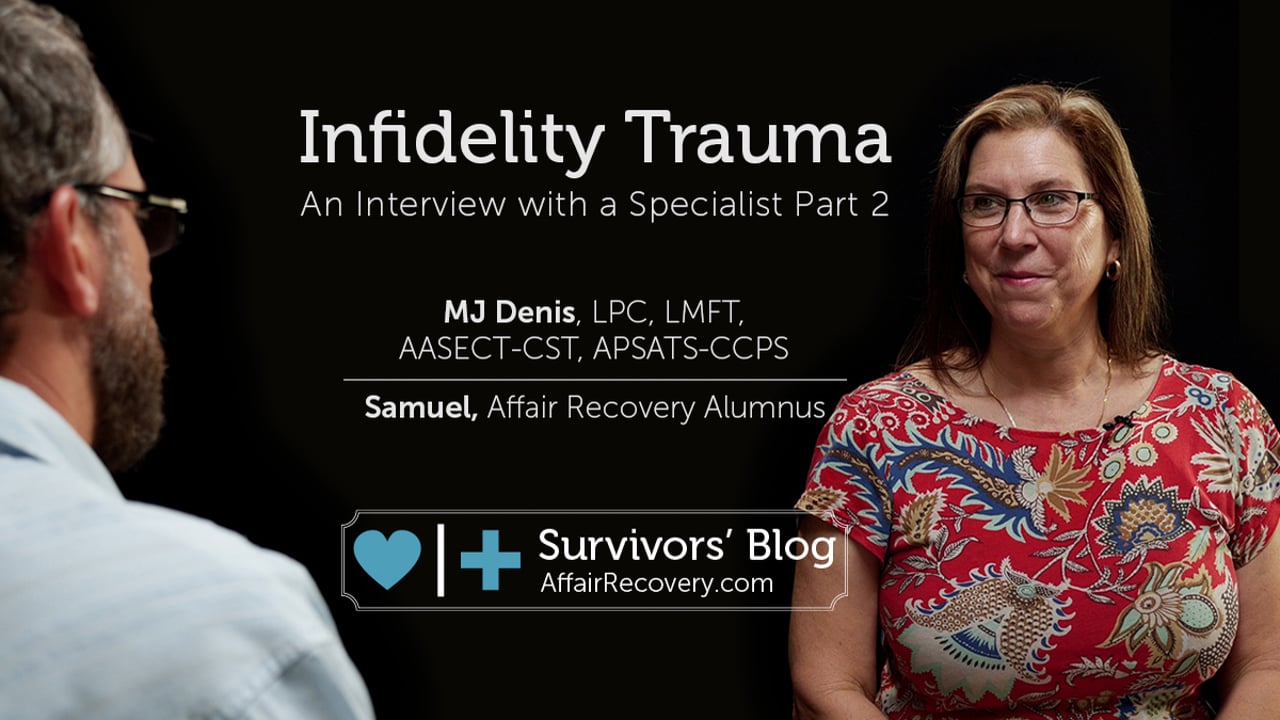
Infidelity Trauma: An Interview with a Specialist Part 2
Watch Part 1
>Viewing Part 2
Samuel interviews MJ Denis, a trauma specialist, about how couples can heal from infidelity.
Continue reading →
Infidelity Trauma: An Interview with a Specialist Part 1
>Viewing Part 1
Watch Part 2
Samuel interviews MJ Denis, a trauma specialist, about how couples can heal from infidelity.
Continue reading →
My Life As A Hurricane
 Our community is used to the threat of tropical weather. Usually, the early notices start with escalated threats that ultimately result in a windy rain storm passing over our area causing very little damage.
In the hours leading up to the arrival of Hurricane Michael it became obvious this storm was going to be different. At 100 miles inland, we were too far north to be part of the normal evacuation plan. Meteorologists began forecasting that the storm would still be holding hurricane strength by the time it reached us. Our home was well within the forecasted cone of the most intense blows. We hunkered down watching the news and tracking the storm through every available medium. Then, just as the storm made landfall on the coast, all power, internet, and cell service was lost. So, we sat . . . and waited . . . not knowing what was coming. As the hours passed, it was impossible to know if what we were experiencing was the worst or just the beginning.
My D-day was May 4, 2017 at 8:00 P.M. I always thought the initial discovery was similar to that feeling you get immediately after hitting your thumb with a hammer. While you can't feel it yet, you know it's about to hurt like hell. As we sat and waited during the storm I realized D-day was also similar to the feeling of waiting on a hurricane. A destructive force beyond my control was on its way, and I had no idea what my world was going to look like in the morning.
As I sat in reflection I began contemplating what the "present me" would say to the "18 months ago me" on the initial night of discovery. No doubt, I have changed in many ways since the night this recovery journey began. I think my insight would've sounded something like this:
You have just experienced major trauma, and this is going to take a lot longer to make sense of than you can comprehend right now. While some of the unexplainable problems in your marriage just became crystal clear, others will not be evident for some time.
You only knew parts of your wife. There is a darkness in her that was fostered at a young age by years of abuse and dysfunction that developed her into a woman who was capable of using sex as a coping skill. In her current state, she is unconscionably self-absorbed, allowing herself to be destructively consumed with satisfying an unquenchable need to be validated and praised. You did not create this, you could not have known it was coming, and you cannot fix her. Therefore, we are not going to focus on her. Our energy is needed elsewhere - we have work to do to save you.
There is great opportunity in what lies ahead. Whether you accept it or not, it is about to become painfully obvious how little control you have over anyone around you; especially your wife. For a while, you will have great trouble controlling your own mind and emotions. Dark emotions will consume you and visions of deviant and disgusting betrayals by your wife will haunt your thoughts. You will not be able to eat or sleep and you will feel more alone than you ever knew was possible. For the first time in your life, death will seem like a viable solution to your problems. At times, you are going to want desperately to sweep the betrayals away and move on quickly. Fight this urge, it will not work. Walk through where you are now and remember that this pain is really just a feeling. It is small and you are greater than it is. I will have to remind you of this fact often as we walk ahead. The only way to the other side, with you intact, is to fully immerse yourself in grieving all you have lost. The process will have many similarities to the one you experienced when you lost your father too early, but the pain will be greater, and the isolation will be new.
Practically speaking, you are going to need some professional help… as soon as you can get it. Unfortunately, it may not be easy to find. Infidelity as a trauma is relatively new science, and it is lagging in its development, especially for betrayed men. Family, friends, your church, even many therapists who mean well and truly care for you, simply do not know how to help. Know that competent resources are out there, but be patient in locating the right source. This is a marathon, not a sprint, and we need to start with the right help.
Friendships are going to shift. Some old friends will grow distant while new friends will emerge. Relationships that were safe places to share the struggles of life with yesterday may not be today. Just let this be. Your instincts to be cautious in who you talk to about this are healthy. We are going to lean on God like you never have before; He has you. He will provide help. We just have to humble ourselves to accept it, even when it comes in unexpected forms.
For years you have given sound judgment to clients in your law practice advising them not to make decisions quickly or based on emotions. As you say, "If it is a good idea today, then it will be a good idea tomorrow." Now it's time for you to follow your own advice. Do not make any major decisions about anything you do not have to until you know you are ready. This may take a long time.
Do you remember that guy in high school? The Ferris Bueller type who seemed to be as comfortable with the nerds as he was the jocks? You remember how people followed you in college, how you could bridge a room divided in opinions and personalities? While you are grown up now and know well how to navigate black tie evenings and complex negotiations, perhaps it's time to admit you are still more comfortable at the kids' table come Thanksgiving. Somewhere along the way we let pieces of you get overrun with ambition and achievement. Let's take the time needed to go find those lost traits again, they are valuable.
It is time to remember where you came from, the integrity of your parents and grandfather, the values they modeled for you. Oh . . . and that faith of yours that you've become so casual with… why is that?
Time will tell what becomes of her. You allowed yourself to be defined by your marriage and in doing so you created an idol of it. God only wants relationships that grow His will for you, and His will is never to harm you. Yes . . . that means you are greater than your marriage. You are not defined by her selfish and humiliating acts. Patience and grace on yourself my friend.
We will rise.
Our community is used to the threat of tropical weather. Usually, the early notices start with escalated threats that ultimately result in a windy rain storm passing over our area causing very little damage.
In the hours leading up to the arrival of Hurricane Michael it became obvious this storm was going to be different. At 100 miles inland, we were too far north to be part of the normal evacuation plan. Meteorologists began forecasting that the storm would still be holding hurricane strength by the time it reached us. Our home was well within the forecasted cone of the most intense blows. We hunkered down watching the news and tracking the storm through every available medium. Then, just as the storm made landfall on the coast, all power, internet, and cell service was lost. So, we sat . . . and waited . . . not knowing what was coming. As the hours passed, it was impossible to know if what we were experiencing was the worst or just the beginning.
My D-day was May 4, 2017 at 8:00 P.M. I always thought the initial discovery was similar to that feeling you get immediately after hitting your thumb with a hammer. While you can't feel it yet, you know it's about to hurt like hell. As we sat and waited during the storm I realized D-day was also similar to the feeling of waiting on a hurricane. A destructive force beyond my control was on its way, and I had no idea what my world was going to look like in the morning.
As I sat in reflection I began contemplating what the "present me" would say to the "18 months ago me" on the initial night of discovery. No doubt, I have changed in many ways since the night this recovery journey began. I think my insight would've sounded something like this:
You have just experienced major trauma, and this is going to take a lot longer to make sense of than you can comprehend right now. While some of the unexplainable problems in your marriage just became crystal clear, others will not be evident for some time.
You only knew parts of your wife. There is a darkness in her that was fostered at a young age by years of abuse and dysfunction that developed her into a woman who was capable of using sex as a coping skill. In her current state, she is unconscionably self-absorbed, allowing herself to be destructively consumed with satisfying an unquenchable need to be validated and praised. You did not create this, you could not have known it was coming, and you cannot fix her. Therefore, we are not going to focus on her. Our energy is needed elsewhere - we have work to do to save you.
There is great opportunity in what lies ahead. Whether you accept it or not, it is about to become painfully obvious how little control you have over anyone around you; especially your wife. For a while, you will have great trouble controlling your own mind and emotions. Dark emotions will consume you and visions of deviant and disgusting betrayals by your wife will haunt your thoughts. You will not be able to eat or sleep and you will feel more alone than you ever knew was possible. For the first time in your life, death will seem like a viable solution to your problems. At times, you are going to want desperately to sweep the betrayals away and move on quickly. Fight this urge, it will not work. Walk through where you are now and remember that this pain is really just a feeling. It is small and you are greater than it is. I will have to remind you of this fact often as we walk ahead. The only way to the other side, with you intact, is to fully immerse yourself in grieving all you have lost. The process will have many similarities to the one you experienced when you lost your father too early, but the pain will be greater, and the isolation will be new.
Practically speaking, you are going to need some professional help… as soon as you can get it. Unfortunately, it may not be easy to find. Infidelity as a trauma is relatively new science, and it is lagging in its development, especially for betrayed men. Family, friends, your church, even many therapists who mean well and truly care for you, simply do not know how to help. Know that competent resources are out there, but be patient in locating the right source. This is a marathon, not a sprint, and we need to start with the right help.
Friendships are going to shift. Some old friends will grow distant while new friends will emerge. Relationships that were safe places to share the struggles of life with yesterday may not be today. Just let this be. Your instincts to be cautious in who you talk to about this are healthy. We are going to lean on God like you never have before; He has you. He will provide help. We just have to humble ourselves to accept it, even when it comes in unexpected forms.
For years you have given sound judgment to clients in your law practice advising them not to make decisions quickly or based on emotions. As you say, "If it is a good idea today, then it will be a good idea tomorrow." Now it's time for you to follow your own advice. Do not make any major decisions about anything you do not have to until you know you are ready. This may take a long time.
Do you remember that guy in high school? The Ferris Bueller type who seemed to be as comfortable with the nerds as he was the jocks? You remember how people followed you in college, how you could bridge a room divided in opinions and personalities? While you are grown up now and know well how to navigate black tie evenings and complex negotiations, perhaps it's time to admit you are still more comfortable at the kids' table come Thanksgiving. Somewhere along the way we let pieces of you get overrun with ambition and achievement. Let's take the time needed to go find those lost traits again, they are valuable.
It is time to remember where you came from, the integrity of your parents and grandfather, the values they modeled for you. Oh . . . and that faith of yours that you've become so casual with… why is that?
Time will tell what becomes of her. You allowed yourself to be defined by your marriage and in doing so you created an idol of it. God only wants relationships that grow His will for you, and His will is never to harm you. Yes . . . that means you are greater than your marriage. You are not defined by her selfish and humiliating acts. Patience and grace on yourself my friend.
We will rise.
Our community is used to the threat of tropical weather. Usually, the early notices start with escalated threats that ultimately result in a windy rain storm passing over our area causing very little damage.
In the hours leading up to the arrival of Hurricane Michael it became obvious this storm was going to be different. At 100 miles inland, we were too far north to be part of the normal evacuation plan. Meteorologists began forecasting that the storm would still be holding hurricane strength by the time it reached us. Our home was well within the forecasted cone of the most intense blows. We hunkered down watching the news and tracking the storm through every available medium. Then, just as the storm made landfall on the coast, all power, internet, and cell service was lost. So, we sat . . . and waited . . . not knowing what was coming. As the hours passed, it was impossible…
Continue reading →
Samuel Addresses the Statement: 'I Don't Know If I Believe in Us Anymore.'
Samuel addresses the situation where a couple may not believe in their marriage again.
Continue reading →
Why Does My Unfaithful Spouse Say I'm Too Controlling?
Samuel answers a viewers question and also explains why an unfaithful spouse may label their betrayed spouse controlling.
Continue reading →
When Shame Has the Last Word
 Shame.
I hate the word. I hate the feeling. I am guessing for most of you reading this, you have more than a vague idea of what this word does to a human being and how it can be one of the most destructive forces on the planet.
I am so tired of shame.
Sure, I can sit here and look back on my life and the things that happened before I had a choice in the matter. Reflect on the things that helped shape my heart into a giant bucket of shame. But the reality is I took shame, let it have authority over me, and ran with it most of my life.
Shame can have many definitions and I'm certain it can have different faces for different people. For me, it has mostly felt like a pit in the deepest parts of my heart (and more tangibly my stomach and my throat) that something is very wrong with me and I am deeply inadequate.
As early as I can remember, I have had this feeling.
To compensate for shame, I would try harder. I would find a way to outperform it, outrun it, or at least cover it up so no one would see it. In an attempt to outrun shame I became the smartest, nicest, most entertaining, funniest, best, most outgoing, and winningest shell of a person that ever existed. I was determined to be successful at everything. I would become everyone's friend. I would never disappoint anyone if I could help it. I would seek approval everywhere. Just take a look at my high school year book. It screams of a girl who sought affirmation everywhere.
Unfortunately my mentality also impacted my spouse.
My husband could never be enough. I mirrored in him my unattainable quest for perfection. I had no idea what intimacy was and destroyed our marriage by not only making it all about me, but seeking all the wrong things in all the wrong places.
A truth that continues to open my eyes is how self-absorbing shame can be. Rick teaches how shame and pride are both a far cry from the place of humility and confidence that God longs for us to find.
Shame is always there, always waiting to devour and pounce. Just today, as I looked on the Affair Recovery website for encouragement, shame crept in.
It whispered rather loudly,
"You are an unfaithful woman. You are the minority. Stay silent. Don't speak out or say anything. It won't be enough and you won't be understood. Stay in the shadows because nothing you say will be believed. You have no right to say anything because of what you've done."
I remember reading a study on how authorities recognize counterfeit dollar bills. It does not happen by studying all of the counterfeits. Instead, they study the real thing. Day after day, they continue to study an authentic dollar bill. They become so familiar with the real thing, it helps them recognize when it's fake.
The same applies to shame. Focusing on the truth helps counteract shame. I am not smart enough to find truth on my own, which is why I find God's word and truth so helpful. I have found it to be the best place to start unraveling the many lies shame speaks. And by studying the real thing, I am slowly learning to see what counterfeits sound and look like.
If you are struggling with shame today, please know you aren't alone. In the darkest days of recovery, I desperately wanted to curl up in a ball and cry out that I deserve nothing more than a life of misery and self-hatred from the choices I made. Not only does that not offer help to anyone but just hear the overwhelming selfishness of that statement! Only when I can look up, reach out, and come outside of that dark place can I begin to see my husband. Consider his feelings. Be curious about what this has been like for him. Possibly offer him some much needed hope or encouragement, even if it is as small as:
"I see you."
"I am not giving up."
"I am sorry that my own shame has caused such abandonment for you."
I am fighting shame.
One of the best ways I have found to combat shame is to enter into one of the Affair Recovery online small groups. For me, it was Hope for Healing. I discovered I wasn't alone in any of these feelings but I desperately need help learning how to fight them and not act out of destructive feelings.
And tangibly, when others can know every dark and ugly thing about me and still find me worthy, I strangely start to see myself differently.
Furthermore, they help provide accountability for helping identify when I want to spiral into shame and negativity. I hate shame. And rightfully so. God hates it too.
Shame.
I hate the word. I hate the feeling. I am guessing for most of you reading this, you have more than a vague idea of what this word does to a human being and how it can be one of the most destructive forces on the planet.
I am so tired of shame.
Sure, I can sit here and look back on my life and the things that happened before I had a choice in the matter. Reflect on the things that helped shape my heart into a giant bucket of shame. But the reality is I took shame, let it have authority over me, and ran with it most of my life.
Shame can have many definitions and I'm certain it can have different faces for different people. For me, it has mostly felt like a pit in the deepest parts of my heart (and more tangibly my stomach and my throat) that something is very wrong with me and I am deeply inadequate.
As early as I can remember, I have had this feeling.
To compensate for shame, I would try harder. I would find a way to outperform it, outrun it, or at least cover it up so no one would see it. In an attempt to outrun shame I became the smartest, nicest, most entertaining, funniest, best, most outgoing, and winningest shell of a person that ever existed. I was determined to be successful at everything. I would become everyone's friend. I would never disappoint anyone if I could help it. I would seek approval everywhere. Just take a look at my high school year book. It screams of a girl who sought affirmation everywhere.
Unfortunately my mentality also impacted my spouse.
My husband could never be enough. I mirrored in him my unattainable quest for perfection. I had no idea what intimacy was and destroyed our marriage by not only making it all about me, but seeking all the wrong things in all the wrong places.
A truth that continues to open my eyes is how self-absorbing shame can be. Rick teaches how shame and pride are both a far cry from the place of humility and confidence that God longs for us to find.
Shame is always there, always waiting to devour and pounce. Just today, as I looked on the Affair Recovery website for encouragement, shame crept in.
It whispered rather loudly,
"You are an unfaithful woman. You are the minority. Stay silent. Don't speak out or say anything. It won't be enough and you won't be understood. Stay in the shadows because nothing you say will be believed. You have no right to say anything because of what you've done."
I remember reading a study on how authorities recognize counterfeit dollar bills. It does not happen by studying all of the counterfeits. Instead, they study the real thing. Day after day, they continue to study an authentic dollar bill. They become so familiar with the real thing, it helps them recognize when it's fake.
The same applies to shame. Focusing on the truth helps counteract shame. I am not smart enough to find truth on my own, which is why I find God's word and truth so helpful. I have found it to be the best place to start unraveling the many lies shame speaks. And by studying the real thing, I am slowly learning to see what counterfeits sound and look like.
If you are struggling with shame today, please know you aren't alone. In the darkest days of recovery, I desperately wanted to curl up in a ball and cry out that I deserve nothing more than a life of misery and self-hatred from the choices I made. Not only does that not offer help to anyone but just hear the overwhelming selfishness of that statement! Only when I can look up, reach out, and come outside of that dark place can I begin to see my husband. Consider his feelings. Be curious about what this has been like for him. Possibly offer him some much needed hope or encouragement, even if it is as small as:
"I see you."
"I am not giving up."
"I am sorry that my own shame has caused such abandonment for you."
I am fighting shame.
One of the best ways I have found to combat shame is to enter into one of the Affair Recovery online small groups. For me, it was Hope for Healing. I discovered I wasn't alone in any of these feelings but I desperately need help learning how to fight them and not act out of destructive feelings.
And tangibly, when others can know every dark and ugly thing about me and still find me worthy, I strangely start to see myself differently.
Furthermore, they help provide accountability for helping identify when I want to spiral into shame and negativity. I hate shame. And rightfully so. God hates it too.
Shame.
I hate the word. I hate the feeling. I am guessing for most of you reading this, you have more than a vague idea of what this word does to a human being and how it can be one of the most destructive forces on the planet.
I am so tired of shame.
Sure, I can sit here and look back on my life and the things that happened before I had a choice in the matter. Reflect on the things that helped shape my heart into a giant bucket of shame. But the reality is I took shame, let it have authority over me, and ran with it most of my life.
Shame can have many definitions and I'm certain it can have different faces for different people. For me, it has mostly felt like a pit in the deepest parts of my heart (and more tangibly my stomach and my throat) that something is very wrong with me and I am deeply inadequate.
As early as I can remember, I have had this feeling.
…
Continue reading →
When Is an Ultimatum Necessary in Healing From Infidelity?
Samuel discusses when and how to use an ultimatum in recovery work.
Continue reading →
A Word of Encouragement for Those Struggling to Go on in Recovery
Samuel shares hope and tangible encouragement for those struggling to find hope.
Continue reading →
Chutes and Ladders
 A good friend of mine, and fellow betrayed husband (yes, we met at an EMS weekend), coined it best when he said, "This isn't highs and lows; it's chutes and ladders." All of us on this journey have experienced the hope generated by progress. Then, seemingly out of nowhere, the bottom falls out and in the moment all hope seems lost.
Which way is up?
I am now 16 months out from my first D-Day, 9 months from my last, and if there is one word that can describe the spot I seem to circle when the chutes open underneath me, it's "disorienting". I understand what happened. My wife is doing the hard work of self-discovery: linking childhood abuses to her adulterous behavior, showing empathy and remorse, leading classes, and attending volumes of counseling. I have grown from someone who was convinced that I had never met a shrink who didn't need one, to the guy craving his next individual session. However, even amongst all this work and progress, I often circle back to an empty feeling. How could I have been so wrong about who she was? The day before my first D-day I would've sworn there was absolutely no way on earth she would have ever been unfaithful at any time in our 23+year relationship. But she was deep in her 4th affair . . .
Despite having committed myself to my own healing journey, there have been many personal slips along the way. I have turned to old habits of rage, excessive slips with alcohol, intentionally isolating myself, and trying to ignore my reality. In each case, the emptiness just lingers. When I'm in the hole of darkness, it is hard to remember what it felt like not to be, even if that was only a few hours ago. Funny thing is, when I'm not in it, I often do not stop to enjoy the peace of contentment.
The more I grow in my own journey of self-discovery, the more I begin to see my situation from a higher level - the forest for the trees. I have learned that when I can only see the trunks of the trees and only focus on an unanswerable question or two, then I am in a space that is simply irrational. I am only passing through this space and, in time, it will end as it always has. As elementary as the words are, it has taken me this long to truly comprehend that every feeling has a beginning, middle, and end. If the feeling is dark, then I have hope that the end of the darkness draws closer with each second. If it is good, then an awareness that I should enjoy and experience it helps extend the peace.
I am told the pros call this "mindfulness". In layman's verbage, I'd say it's simply getting my head out of my rear. Regardless of how sophisticated you would like to be in your interpretation, I think we can all benefit by regular reminders to have a little grace on yourself and do what you can to stay in this moment and out of the past.
For me, these efforts at self-care have reignited an old passion with bird hunting and all things hunting dogs. Dare I say I have even discovered that some simple childhood pleasures like peanut butter and junk food shouldn't be ignored. Yes, even at 47 years old, puppies and ice cream can work wonders.
Find your way out of the hole, make the effort to realize what works for you, and make it routine. Although the specific resource may be personal, the need for it is universal in this journey we have been thrown into. My hope is that each time I climb out of the hole, a little dirt falls back in it, and next time it will not be as deep. Each time I climb out I am reminded again that God's grace in my life is overwhelming. Even this dark betrayal didn't destroy my thriving law practice, beautiful children, and a wife willing to face her demons.
I am still uncertain how this will end for me, but perhaps that is the greatest lesson I can take from all this: the ability to accept I do not have to know tomorrow, as He's got me today.
A good friend of mine, and fellow betrayed husband (yes, we met at an EMS weekend), coined it best when he said, "This isn't highs and lows; it's chutes and ladders." All of us on this journey have experienced the hope generated by progress. Then, seemingly out of nowhere, the bottom falls out and in the moment all hope seems lost.
Which way is up?
I am now 16 months out from my first D-Day, 9 months from my last, and if there is one word that can describe the spot I seem to circle when the chutes open underneath me, it's "disorienting". I understand what happened. My wife is doing the hard work of self-discovery: linking childhood abuses to her adulterous behavior, showing empathy and remorse, leading classes, and attending volumes of counseling. I have grown from someone who was convinced that I had never met a shrink who didn't need one, to the guy craving his next individual session. However, even amongst all this work and progress, I often circle back to an empty feeling. How could I have been so wrong about who she was? The day before my first D-day I would've sworn there was absolutely no way on earth she would have ever been unfaithful at any time in our 23+year relationship. But she was deep in her 4th affair . . .
Despite having committed myself to my own healing journey, there have been many personal slips along the way. I have turned to old habits of rage, excessive slips with alcohol, intentionally isolating myself, and trying to ignore my reality. In each case, the emptiness just lingers. When I'm in the hole of darkness, it is hard to remember what it felt like not to be, even if that was only a few hours ago. Funny thing is, when I'm not in it, I often do not stop to enjoy the peace of contentment.
The more I grow in my own journey of self-discovery, the more I begin to see my situation from a higher level - the forest for the trees. I have learned that when I can only see the trunks of the trees and only focus on an unanswerable question or two, then I am in a space that is simply irrational. I am only passing through this space and, in time, it will end as it always has. As elementary as the words are, it has taken me this long to truly comprehend that every feeling has a beginning, middle, and end. If the feeling is dark, then I have hope that the end of the darkness draws closer with each second. If it is good, then an awareness that I should enjoy and experience it helps extend the peace.
I am told the pros call this "mindfulness". In layman's verbage, I'd say it's simply getting my head out of my rear. Regardless of how sophisticated you would like to be in your interpretation, I think we can all benefit by regular reminders to have a little grace on yourself and do what you can to stay in this moment and out of the past.
For me, these efforts at self-care have reignited an old passion with bird hunting and all things hunting dogs. Dare I say I have even discovered that some simple childhood pleasures like peanut butter and junk food shouldn't be ignored. Yes, even at 47 years old, puppies and ice cream can work wonders.
Find your way out of the hole, make the effort to realize what works for you, and make it routine. Although the specific resource may be personal, the need for it is universal in this journey we have been thrown into. My hope is that each time I climb out of the hole, a little dirt falls back in it, and next time it will not be as deep. Each time I climb out I am reminded again that God's grace in my life is overwhelming. Even this dark betrayal didn't destroy my thriving law practice, beautiful children, and a wife willing to face her demons.
I am still uncertain how this will end for me, but perhaps that is the greatest lesson I can take from all this: the ability to accept I do not have to know tomorrow, as He's got me today.
A good friend of mine, and fellow betrayed husband (yes, we met at an EMS weekend), coined it best when he said, "This isn't highs and lows; it's chutes and ladders." All of us on this journey have experienced the hope generated by progress. Then, seemingly out of nowhere, the bottom falls out and in the moment all hope seems lost.
Which way is up?
I am now 16 months out from my first D-Day, 9 months from my last, and if there is one word that can describe the spot I seem to circle when the chutes open underneath me, it's "disorienting". I understand what happened. My wife is doing the hard work of self-discovery: linking childhood abuses to her adulterous behavior, showing empathy and remorse, leading classes, and attending volumes of counseling. I have grown from someone who was convinced that I had never met a shrink who didn't need one, to the guy craving his next…
Continue reading →
How the Unfaithful Can Win Back Trust and Safety When Dealing with Infidelity
Samuel shares a significant pointer for the unfaithful spouse trying to win back trust.
Continue reading →
Hope Rising Notification Sign Up
#mc_embed_signup{background:#fff; clear:left; font:14px Helvetica,Arial,sans-serif; }
/* Add your own Mailchimp form style overrides in your site stylesheet or in this style block.
We recommend moving this block and the preceding CSS link to the HEAD of your HTML file. */
Hope Rising Conference Notifications
Subscribe to be the first to know when the date is selected and registration will open. Seating is limited!
* indicates required
Email Address *
First Name *
Last Name *
(function($) {window.fnames = new Array(); window.ftypes = new Array();fnames[0]='EMAIL';ftypes[0]='email';fnames[1]='FNAME';ftypes[1]='text';fnames[2]='LNAME';ftypes[2]='text';fnames[3]='HRYEAR';ftypes[3]='text';}(jQuery));var $mcj = jQuery.noConflict(true);
#mc_embed_signup{background:#fff; clear:left; font:14px Helvetica,Arial,sans-serif; }
/* Add your own Mailchimp form style overrides in your site stylesheet or in this style block.
We recommend moving this block and the preceding CSS link to the HEAD of your HTML file. */
Hope Rising Conference Notifications
Subscribe to be the first to know when the date is selected and registration will open. Seating is limited!
* indicates required
Email Address *
First Name *
Last Name *
(function($) {window.fnames = new Array(); window.ftypes = new Array();fnames[0]='EMAIL';ftypes[0]='email';fnames[1]='FNAME';ftypes[1]='text';fnames[2]='LNAME';ftypes[2]='text';fnames[3]='HRYEAR';ftypes[3]='text';}(jQuery));var $mcj = jQuery.noConflict(true);
Continue reading →
Hope Rising 2018: Apology from the Unfaithful
For Hope Rising 2018, which is now available On Demand, one of our Survivors, Laurie, wrote a beautiful and profound Apology Letter delivered to the betrayed men at the conference. Samuel in turn delivered a version of her letter to the betrayed women. Since the conference, we have been flooded with emails requesting a written or recorded version. We are happy to be able to share these powerful words with you today:
Letter to Betrayed Men
When I began thinking about writing this letter to you all, and considering what I wanted to say, God impressed on me to set aside what I wanted to say to you for a moment, and start with what He would say first.
He would tell you that you are his child and He loves you beyond your understanding; that you are not a disappointment to him in any way; that you have personal dignity and…
Continue reading →
Three Necessary Recoveries of Infidelity
Samuel shares insight into three recoveries that have to be addressed when healing from infidelity.
Continue reading →
Hope Rising 2018 On Demand
The following videos are from the sold out First Annual Hope Rising Conference for betrayed spouses on Oct. 6th 2018. If you are interested in attending the next annual Hope Rising Conference, either in person or live streamed, learn more here: www.affairrecovery.com/hope-rising
Continue reading →
Unfairness
 Today in counseling I was stunned by a concept I’ve heard most my life. Similar to the old quilt that covers our bed, I became so familiar with it I no longer saw the depth of beauty in it.
My counselor asked me how I felt I was doing at “feeling my husband’s pain”. He has a way of asking a simple question and patiently waits for me to take as long as I need to respond. Having been a counselor for over 40 years, he sees right through me and my crap most days.
How am I doing with handling my husband’s pain? You mean the pain I created with MY infidelity?
In the silence of that moment I found myself wanting. I wanted to say that I’ve tried to feel it. I wanted to justify all of the ways I’ve tried to be sensitive and aware of him. I wanted to defend the times I’ve spent the past year trying to be safe for him in his pain. But none of those words came out. Instead I sat and squirmed. More silence. An awkward, heavy, deep-in-my-chest feeling came over me. The former me would have avoided the question all together and hung my head in shame. But as I sat there, the most honest answer I could muster was “probably not well at all.” The reality in that overwhelming and empty moment was a painful and sad truth; I had not felt my husband’s pain at all.
I mean how could I really know my husband’s pain? Although I try to imagine what it would be like to be him, to realize the person you were married to was nothing more than a stranger who kept secrets, I still can’t truly understand. I can try to feel it. I can practice listening really well. I can reflect back to him when he shares. I can be safe. I can give him passwords and whereabouts. On our better days I can even offer some perspective and insight. But the reality is I will never feel the depth of how much I hurt him.
As my therapist and I sat in uncomfortable, tender silence, he graciously allowed me to feel the unfairness of my infidelity.
Have you heard Jesus’ parable of the talents? If you’re familiar with this story, I think you’d agree that it is one of gross unfairness. This parable is about one guy who works really hard to earn his day’s wage. He works ALL day, outside in a vineyard. Then for the last hour of the day some lazy, irresponsible loser comes in and puts the finishing touches on the work. At the end of the day, the owner pays both of them the exact same amount. Huh?
How is it that God can offer both of us the same grace, the same forgiveness and the same chance at life when I was the one who chose to break our vows? Why is it that my husband has to bear so much of the pain when he didn’t do anything to deserve it?
Today was a difficult day. I think I finally realized how deep our need for grace really is. And while I certainly hope my husband can heal from all of the pain I caused him, I cannot earn his mercy.
If there was a way I could earn grace or mercy, I would. I think any repentant unfaithful spouse would tell you it would almost be easier if there was a way we could earn, work, buy or barter some kind of mercy. But there’s not. We have to live in the great but painful space of humility.
Not much farther, the Bible tells us what deeply moves Jesus: people who want to see.
Jesus doesn’t need anything from me. He just loves me. He always has. He always will – even when I am unlovable. He just wants me to be willing.
My hope is that we all become willing to find something more. That we never be unwilling to learn nor be afraid of humility the way I was and sometimes still am.
If you haven’t been to an EMS weekend, go! Or if you haven’t taken one of the Affair Recovery online classes, believe me when I say they are life changing. Start for free with the 7 Day Bootcamp. At the very least, get your butt into counseling. While it can’t change the unfairness of the past or the pain, it may be able to help your spouse heal.
Today in counseling I was stunned by a concept I’ve heard most my life. Similar to the old quilt that covers our bed, I became so familiar with it I no longer saw the depth of beauty in it.
My counselor asked me how I felt I was doing at “feeling my husband’s pain”. He has a way of asking a simple question and patiently waits for me to take as long as I need to respond. Having been a counselor for over 40 years, he sees right through me and my crap most days.
How am I doing with handling my husband’s pain? You mean the pain I created with MY infidelity?
In the silence of that moment I found myself wanting. I wanted to say that I’ve tried to feel it. I wanted to justify all of the ways I’ve tried to be sensitive and aware of him. I wanted to defend the times I’ve spent the past year trying to be safe for him in his pain. But none of those words came out. Instead I sat and squirmed. More silence. An awkward, heavy, deep-in-my-chest feeling came over me. The former me would have avoided the question all together and hung my head in shame. But as I sat there, the most honest answer I could muster was “probably not well at all.” The reality in that overwhelming and empty moment was a painful and sad truth; I had not felt my husband’s pain at all.
I mean how could I really know my husband’s pain? Although I try to imagine what it would be like to be him, to realize the person you were married to was nothing more than a stranger who kept secrets, I still can’t truly understand. I can try to feel it. I can practice listening really well. I can reflect back to him when he shares. I can be safe. I can give him passwords and whereabouts. On our better days I can even offer some perspective and insight. But the reality is I will never feel the depth of how much I hurt him.
As my therapist and I sat in uncomfortable, tender silence, he graciously allowed me to feel the unfairness of my infidelity.
Have you heard Jesus’ parable of the talents? If you’re familiar with this story, I think you’d agree that it is one of gross unfairness. This parable is about one guy who works really hard to earn his day’s wage. He works ALL day, outside in a vineyard. Then for the last hour of the day some lazy, irresponsible loser comes in and puts the finishing touches on the work. At the end of the day, the owner pays both of them the exact same amount. Huh?
How is it that God can offer both of us the same grace, the same forgiveness and the same chance at life when I was the one who chose to break our vows? Why is it that my husband has to bear so much of the pain when he didn’t do anything to deserve it?
Today was a difficult day. I think I finally realized how deep our need for grace really is. And while I certainly hope my husband can heal from all of the pain I caused him, I cannot earn his mercy.
If there was a way I could earn grace or mercy, I would. I think any repentant unfaithful spouse would tell you it would almost be easier if there was a way we could earn, work, buy or barter some kind of mercy. But there’s not. We have to live in the great but painful space of humility.
Not much farther, the Bible tells us what deeply moves Jesus: people who want to see.
Jesus doesn’t need anything from me. He just loves me. He always has. He always will – even when I am unlovable. He just wants me to be willing.
My hope is that we all become willing to find something more. That we never be unwilling to learn nor be afraid of humility the way I was and sometimes still am.
If you haven’t been to an EMS weekend, go! Or if you haven’t taken one of the Affair Recovery online classes, believe me when I say they are life changing. Start for free with the 7 Day Bootcamp. At the very least, get your butt into counseling. While it can’t change the unfairness of the past or the pain, it may be able to help your spouse heal.
Today in counseling I was stunned by a concept I’ve heard most my life. Similar to the old quilt that covers our bed, I became so familiar with it I no longer saw the depth of beauty in it.
My counselor asked me how I felt I was doing at “feeling my husband’s pain”. He has a way of asking a simple question and patiently waits for me to take as long as I need to respond. Having been a counselor for over 40 years, he sees right through me and my crap most days.
How am I doing with handling my husband’s pain? You mean the pain I created with MY infidelity?
In the silence of that moment I found myself wanting. I wanted to say that I’ve tried to feel it. I wanted to justify all of the ways I’ve tried to be sensitive and aware of him. I wanted to defend the times I’ve spent the past year trying to be safe for him in his pain. But none of those words came out. Instead I sat and…
Continue reading →
What Is Rewriting History in Healing from Infidelity?
Samuel shares insight into the tactic of 'rewriting history' and how to recover from it.
Continue reading →
How Do You Know If You're Too Far Gone to Be Saved?
Samuel discusses the common question in recovery; are we too far gone to be healed?
Continue reading →
Healing from Infidelity: Stop Defending the 10%
Samuel discusses a trap many unfaithful spouses fall into in recovery.
Continue reading →
My Spouse Is Not My Report Card: Avoiding Self Hatred in Recovery
Samuel shares a controversial but powerful approach to finding true healing.
Continue reading →
How Do You Forgive the Affair Partner?
Samuel shares insight into how to forgive the affair partner after the discovery of infidelity.
Continue reading →
Are You Dealing with Therapist Induced Trauma after Infidelity?
Samuel discusses how we can be traumatized by well meaning therapists and authority figures.
Continue reading →
How To Be Okay When Things Are Not Okay
"Learn how to be okay
when things are not okay."
When I first heard this statement I thought it was dumb and much too simple. It was almost insulting – like trying to treat an intensive care
wound with a band aid.
However, ten long months into recovery, this statement has been a foundational thought
in getting through many hard days.
Like many unfaithful spouses, my tendency and need to control situations have been off the charts. When you are hiding behind your affair, there is an illusion of control (and complete self-absorption) you live under because you never think about the harsh reality that you might lose your spouse because of your decisions. Much like the character in the Wizard of Oz, an insecure shell of a man hiding behind an image, walking in the truth of my actions has revealed my insecurity, shame and fear like no other. It has been terrifying to face both the pain my actions have caused as well as the waiting while my spouse chooses whether to stay or go. But I’m learning, albeit slowly, how to become okay even when everything else isn’t.
If you also navigate dark days of uncertainty where you feel anything but okay, I want to share some of the ways I have found solace in the storm:
Focus your eyes on something constant and bigger than yourself. For me that has been Christ. I must keep my eyes focused on Him. If you do not subscribe to faith I recommend putting your belief in something bigger than your humanity or your spouse’s choice to stay or go.
Take a break from all social media. Not only am I too vulnerable and fragile to carry or care about the on-goings of the world, but it’s also too much of a trigger for me as I do not want to associate in any way with my past life. The temptation is too great.
Pay attention to what you listen to. When I’m not listening to a hymn that speaks truth, or a podcast that helps me heal, then I usually find that I simply need quiet. This means slowing down, less radio, less TV, less overall noise and junk.
Feel the feelings. Like my husband and most of you, I don’t like uncomfortable feelings. Particularly when I feel ashamed, alone, discouraged, angry, hurt or afraid. But the only way out of feelings is through them. Choosing to not feel is what got me into this mess initially. When I choose to feel I can remind myself it will be okay and it will eventually pass.
Find a group or community of people that share your pain. Hope for Healing and Harboring Hope are life lines to fellow people who share our hurt. Through their stories we begin to see how far we’ve come and how far we still have to go. It is so incredibly comforting to know we are not the only ones who have felt this way or have been through this.
Some days in recovery can feel like an eternity. The pain can be so intense that it feels like anything but normal or okay. But there’s something I’m beginning to realize. On the days I’m not okay, I notice details and moments I’ve missed during all my years of hiding and making it about me. I am now acutely aware of my new found clarity and gratitude.
Just the other day I couldn’t stop looking at the color of my husband’s eyes. Perhaps the road we have traveled thus far has made me see them in a shade of blue I had never noticed in all of our years together.
In the midst of the stillness, quiet, and sadness, I can find appreciation for things I would have previously overlooked.
And...
I’m still breathing. Although my heart is breaking, it is still beating. The sun continues to rise in the morning and its beauty is indescribable.
Even though my marriage remains uncertain, I know God is still at work. Knowing this helps me be okay without it being okay. I hope and pray the same for you.
"Learn how to be okay
when things are not okay."
When I first heard this statement I thought it was dumb and much too simple. It was almost insulting – like trying to treat an intensive care
wound with a band aid.
However, ten long months into recovery, this statement has been a foundational thought
in getting through many hard days.
Like many unfaithful spouses, my tendency and need to control situations have been off the charts. When you are hiding behind your affair, there is an illusion of control (and complete self-absorption) you live under because you never think about the harsh reality that you might lose your spouse because of your decisions. Much like the character in the Wizard of Oz, an insecure shell of a man hiding behind an image, walking in the truth of my actions has revealed my insecurity, shame and fear like no other. It has been…
Continue reading →
Dissecting a Common Mistake When Healing from Infidelity
Samuel shares insight into a common mistake couples make in recovering from infidelity or addiction.
Continue reading →
When You Feel Alone after Infidelity
Samuel shares the proper motivation for recovery work after infidelity for both spouses.
Continue reading →
Why Fixing Your Spouse Is Not the Answer to Healing from Infidelity
Samuel discusses a necessary paradigm shift if couples are going to heal from infidelity.
Continue reading →
Help for the Unfaithful Spouse: Starting Life over Again
Samuel shares his own experience in adjusting to life after disclosure and embracing new patterns in life.
Continue reading →